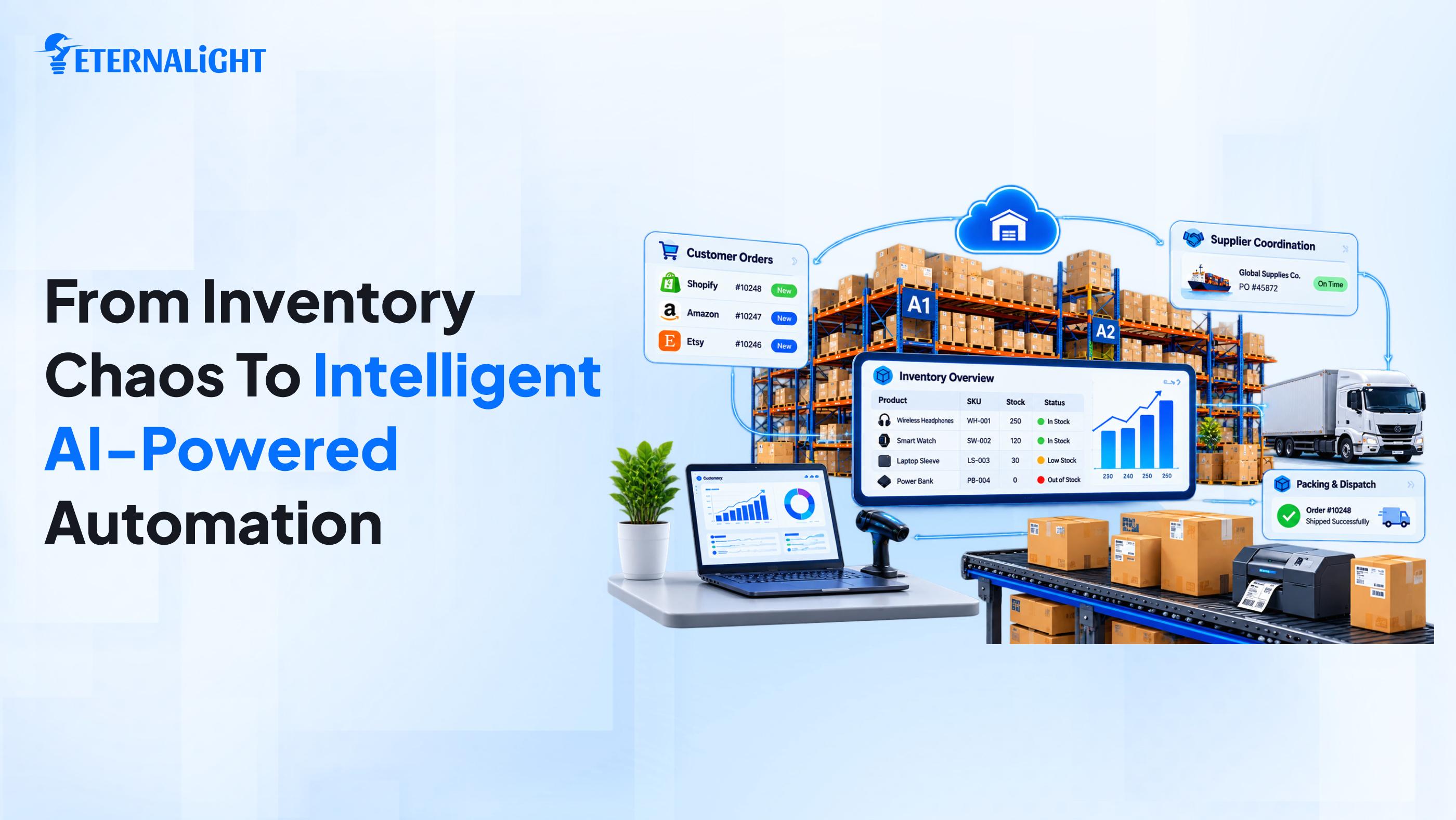
Festive and other seasonal sales drive adrenaline rushes that push customers to buy at discounted prices. So, e-commerce store owners must keep inventory organized to handle the rush. Because these sales usually happen when a product is in demand, it quickly goes out of stock.
But these tasks can’t be managed manually, and the sales team will soon become exhausted. Handling the enormous amount of spreadsheet data is tough, and it gets harder as customers keep connecting.
To take the business online, the owner needs to connect with suppliers, delivery agents, payment gateways, and sales channels, and manage warehouse operations.
Many business owners consider setting up inventory management software in their offices to move away from heavy physical documentation, which can get misplaced or torn up. Yes, the system can visualize data in a spreadsheet, but tracking stock levels is still hard.
In inventory management software systems, business owners initially replaced paperwork with spreadsheets, emails, and chats, but much of the rest remained manual.
But if inventory runs out, or a product isn't available at the moment due to a technical issue, how will the customer or owner be notified?
Automation isn't about adding another tool; it's about managing inventory challenges like stockouts, overstock, waste, or reduced engagement from late deliveries. Serving customers online and offline requires different approaches. You need to protect your budget and support future operations.
So we don’t need a system dashboard for record-keeping, but one that enables action with less human intervention. Automating these tasks improves efficiency and accuracy, helping you meet customer demand on time without inconvenience.
Why Traditional Inventory Management Falls Short?
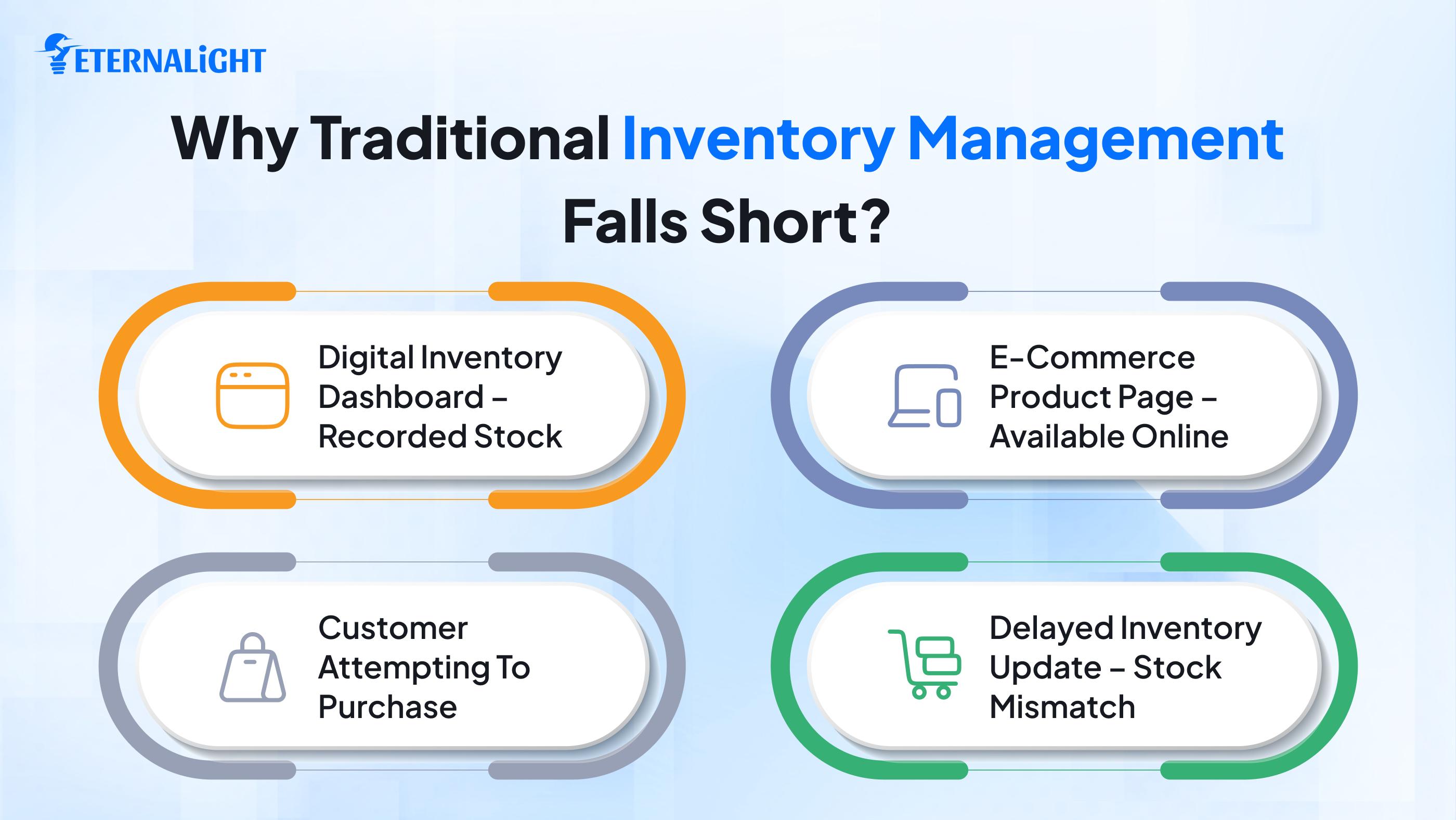
Let's consider the stock dashboard; what you see here is only item details. Which order needs to be delivered?
Who has ordered, the address details, and the product price.
Whether it's retail, logistics, or any other domain, one update, one break, and one missed action may lead to disaster. If the website and app show a product as in stock, but when a customer tries to add it to the cart, it shows as unavailable. That's a serious inventory blunder.
Inventory data must be accurate and updated dynamically online; otherwise, it leads to friction.
Neither overstocking nor understocking is good for the business. You may see a drop in sales, and customers also want to keep inventory in good condition; because of the high volume of items, you may need to hire new staff.
Manual data entry means data is scattered across multiple files and tools, which can lead to redundancy and duplication.
As a business person, you must understand customer interests and requirements, and adapt as they evolve, because errors can create financial risk from incorrect purchases.
If you don’t have accurate information about your warehouse and stock, you can't track what's missing when something is stolen; stock can also be lost due to poor organization and arrangement.
Real World Impact of Blind Inventory and Cash Flow Disruption
We spoke with two clothing store owners; both operate offline. One was in the city center, and the other was also in the center but behind a street. The first served customers across a wide price range and welcomed all kinds of customers, not because of their status, but because they tried to understand what they wanted and at what price point.
They asked customers for their opinion on what additions the store should have, what products and fabric materials to keep, and whether to launch an accessories section.
In contrast, the second store owner treated customers based on their status; they didn’t focus on local customers or budget-range clothes. They sold products at the same price as a sophisticated website or brand.
As a result, the first owner gained more customers quickly. On the other hand, the backstreet shop owner had only a limited number of customers who could afford the budget and rigid prices. They never offered any discounts or sales.
Their stock was full, but they didn't have enough customers to buy those items.
Automated Inventory Management: What It Is?
We can agree that you don't need it on day one to launch an agentic, AI-driven automated inventory management system, but automation is mandatory to run an e-business smoothly.
It reduces manual daily inventory audits, data entry, and incorrect stock data, and improves decision-making for further purchase transactions and billing invoices.
In an automated inventory management system, everything is managed step by step in a loop. If a customer explores a product and sees it's in stock, they add it to the cart, go to the payment screen, select a payment gateway, and complete the purchase. Then the order reaches the customer's location, and if they’re satisfied, they keep it; if they have any issues with the product, they raise a refund or return request.
The system will generate the request on the seller side; there's no guesswork or stuck situation, and the query loop runs until everything is sorted.
The Shift with Agentic AI in Inventory Management
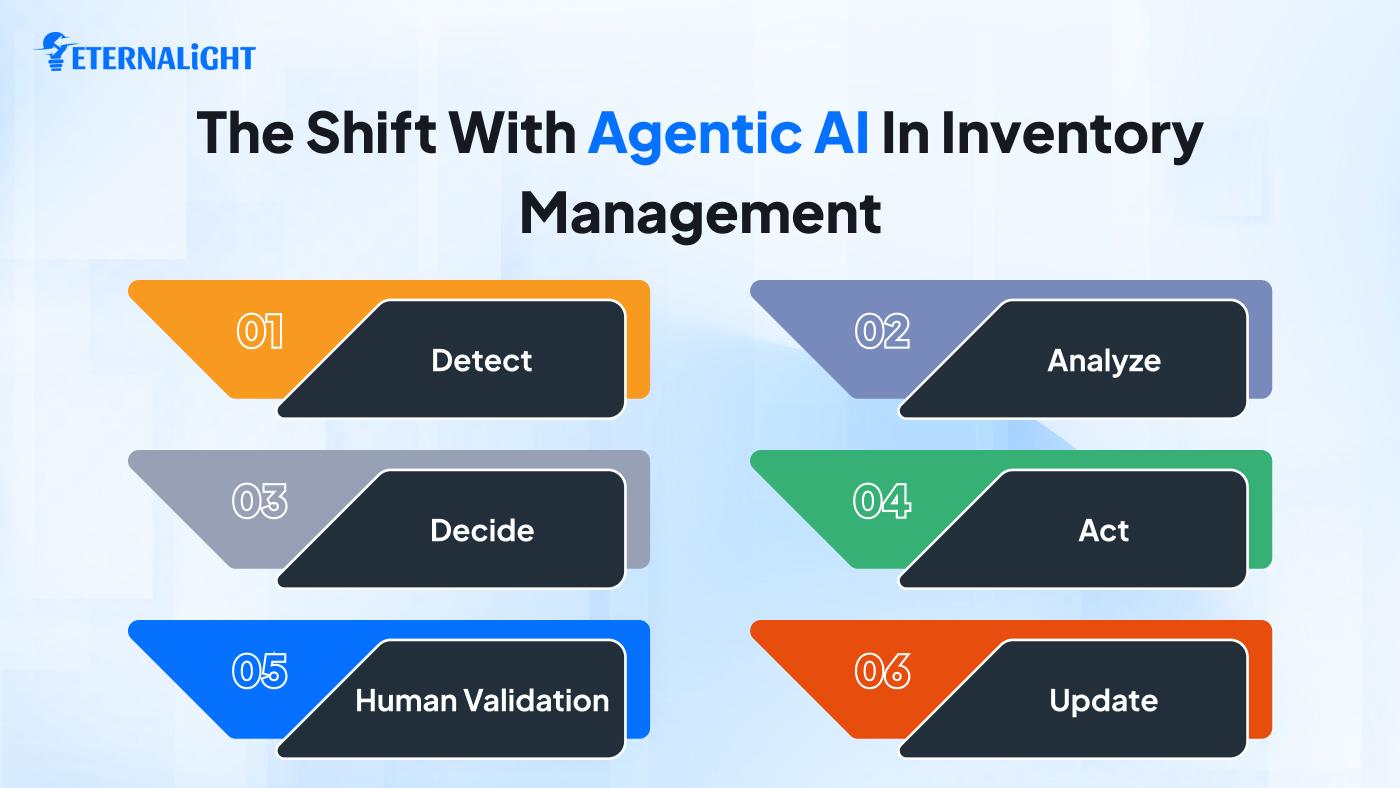
It's time to overcome slow processing and gain transparency and visibility beyond the dashboard. Until now, you’ve seen the count drown in spreadsheets, emails, and alerts about stale inventory data.
But now, with agentic AI, these systems will come into full action, making decisions autonomously with the necessary user consent.
Initially, the inventory management system only triggered an alert, and the responsible person would check the email and other product details.
Now the system not only flags low-stock alerts or refund/return requests, but if we feed it instructions for scenarios like “what to do next ?”, it can independently manage complex workflows.
AI software development companies are now launching systems with reasoning capabilities and a context graph that understands not only the prompt but also the surrounding situation. The agent doesn’t stop at one step of reading the email; it can respond to both the seller and supplier sides, make the necessary changes, remain resilient, and seek human validation.
Key Benefits of AI-driven Inventory Management System
Advancement shouldn’t be limited to automating tasks; it should also manage the role properly as a human, using strong analytical and reasoning capabilities to predict next moves. Agentic AI in inventory management is reshaping workflows and unlocking major advantages.
- Error-prone efficiency and lower cost
- Doing less with a lean workflow
- Audit trails comply with AI governance and compliance
- Eliminating the never-ending loop of data entry, negotiation, and delivery
Practical Processes to Automate Inventory Management

With an AI-driven inventory management system, store owners can maintain accurate counts without the financial burden and better manage customer needs.
So, the use case for automated inventory management software looks like this.
Automate Real-Time Inventory Tracking
No more stale stock; know whether your shelves are well organized and accurately counted by category, with every feature and purchase updating in real time.
Speed Up Inventory Data Entry with Barcode Scanning
While shopping in malls, you may have noticed that during billing, the cashier scans the lines of printed tags; these are secret number combinations that enable error-proof entry and speed up billing and invoice entry in systems.
Set Up Smart Stock Replenishment
Some products stay in demand, while others are seasonal. The AI system must assess when to reorder inventory and how much to keep in buffer, because nothing is fixed; predictive analytics and AI blend here.
Automate Order and Return Processing
If AI agents are at the core of the workflow and fit there, the system can automatically check the status of every order and purchase, from first order to refund, reorder, and all receipts independently.
Track Fast-Moving and Slow-Moving Inventory
We know stores don't run operations on item counts alone; they track which products customers demand most so they can restock them. But customer demand is unpredictable; preferences can change at any time. The system must automatically identify slow movers and fast eaters in advance, before stock runs out.
Manage Inventory Through a Mobile App
Eliminate dependency on desktop-based operations; the business owner must be able to manage inventory from their phone via a mobile app.
Use AI-Driven Inventory Insights
The system might track every purchase and refund request, but what if we need to revisit the data a few weeks later to analyze sales growth?
For that, the system must generate all types of reports to identify patterns and other behavioral insights, because business doesn't run on guesswork but on real-time data.
Automate Expiry Date and Batch Tracking
Outdated products are useless, but contamination, low-quality material, and torn or damaged material are also a problem. Firms in medical, food, and other sectors need an automated inventory management system that can trigger expiry alerts to reduce losses, so stock sells out before it is wasted.
Centralize Inventory Across Multiple Locations
Do you have multiple stores across locations, like Vishal Mart, Vmart, BIBA, Reliance, Westside, and others?
Then keep all data and items updated at once, without separate systems or multiple sheets.
Final Words
Accelerate your business momentum with an automated inventory management system that handles more than just stock and inventory. It assists with orders, replenishment, returns, and other complex business scenarios with minimal human intervention.
With an automated inventory management system, business owners can understand real-time conditions and manage operations by setting workflows, rules, permissions, and instructions that AI agents can follow and execute. This lets business owners focus on other important tasks, like client meetups and other sales operations.
So yes, this AI-driven inventory software isn't replacing the human role; it's driving efficiency and helping businesses make informed decisions.

Ayushi Shrivastava
Senior Content Writer
Ayushi is a Content Strategist at Eternalight Infotech with 4 years of experience in transforming complex ideas into clear, engaging, and SEO optimized narratives. She specializes in crafting impactful content strategies that enhance brand visibility and drive meaningful engagement across digital platforms.
Related Blogs
- AI & ML8 Mins
Codex vs Claude Code: What Sets These Coding Agents Apart?
Compare Codex and Claude Code across execution, integrations, project context, code review, and pricing to understand which suits your development workflow.
- AI & ML6 Mins
Agentic AI Prompting: How to Guide AI Agents Effectively
Learn how to write effective prompts for agentic AI systems with clear goals, tool instructions, failure handling, permission limits, and result validation.
- AI & ML10 Mins
Leading AI Development Companies in the USA for 2026
Searching for an AI development company in the USA? Discover 10 companies offering AI development, GenAI, AI integration, and custom solutions.