Shift Left Testing: How Defining Test Cases Early Can Reduce Bugs

Have you ever built a feature, shipped it confidently, and then started receiving bug reports on your project management boards within hours?
You might be wondering why this happened because during the time of the production phase, you had thoroughly checked, and everything seemed perfect; now suddenly this breakdown is unexpected.
It’s frustrating, time-consuming, and expensive to fix after development is done. It’s not new; it's a daily, chaotic scenario in software development. Sometimes basic scenarios slip through that were never part of the discussion and now occur. What if we could prevent most of these issues before writing even one line of code?
In this blog, we share a brief on how defining test cases before developing products can transform your experience.
Real-World Scenario Without Predefined Test Cases
Imagine a team building a new “Add to Cart” feature for an e-commerce app.
Initially, as they collected project information on features, scope, and deadlines, everything was clear about what needed to be integrated into the app for accessibility. The user journey for purchasing an item also appears straightforward.
“A user visited the app, scrolled, and selected an item to add to the cart, and the items were included, and the cart count was incremented.”
Once developers finish coding, the app passes all radars, and QA takes over in-depth testing. They realize... nobody planned what needs to be tested.
- What if the network is unavailable or poor?
- What if the user logged out?
- Does the app enable cart synchronization across all devices on which users are logged in?
- Does the inventory automatically show that any items are out of stock?
When any user logs in and clicks to add items, the button works, but the cart doesn’t update correctly, discounts don’t apply, and the checkout fails when the internet is slow. Now the team must go back and rebuild multiple pieces again.
This could have been avoided if QA test cases had been defined beforehand.
Why Prefer Shift Left Testing in Software Development
It’s good to stick with the basics, but if we still plan to follow the traditional method of initiating testing after the product is fully delivered, it will be a waste of time due to rework.
- What if the finalized product will not align with the expectation
- Discovering the bug or technical bottlenecks later will delay the release
- Not every bug fix requires a minor adjustment; some need to impact the overall library shift, new functionality, or API
In modern product development, test cases often come after development. But a more innovative approach is “shift-left testing," where testing starts from day one.
By defining test cases early, everyone understands the expected behavior, scope, edge cases, and success criteria clearly.
Shift Left Software Testing: Not Just a Strategy, But a Framework
Just think about it; you have gathered the project and related ideational information. The prototype and wireframe proposed a well-structured UI/UX, which appears perfect at first glance.
Developers implemented the required features, but unfortunately, the issues are mounting.
It's all because behavior at each phase was not validated first and moved on to other phases.
If test cases were planned and validated well along with the requirement gathering, analysis, and UI/UX design phase, teams would get the indicator of whether to rethink and redesign the UI/UX behavior.
Truly, minor negligence leads to a costly mistake.
Defining test cases earlier and following the Shift Left testing method will reduce rework. Instead of ticking the checklist, ensure that every phase is complete and error-free before progressing on the next.
Real Stories of the Development Team Struggled Without Test Case Planning Earlier
Once, a freelance developer was assigned to develop a logistics platform. Based on the project requirements, he designed an interactive UI/UX and other features.
During the testing phase, he discovered that clicking a radio button for gender selection selected all values at once, even though only one value should be selected. While this was a minor fix, it was functionalities. actually an issue.
Later, certain data field values were not being stored in the database. So the developers need to recheck multiple functionality.
Similarly, one developer once said:
“I finished the feature, but half the scenarios were never discussed. I had to rewrite most of it.”
So factually, teams that skip early test case planning often struggle with:
• Requirements changed during development because expectations were unclear.
• Developers code based on assumptions rather than facts.
• QA teams not knowing what to validate and where to start.
• Late fixes are causing delays and increased cost.
• Users facing broken experiences in production.
Well, whatever it is, it's not because they have a lack of experience but because of the process gap.
Read more on how our QA team does E2E testing with Cypress automatically.
How to Write Test Cases Before Production: The Blueprint for Development
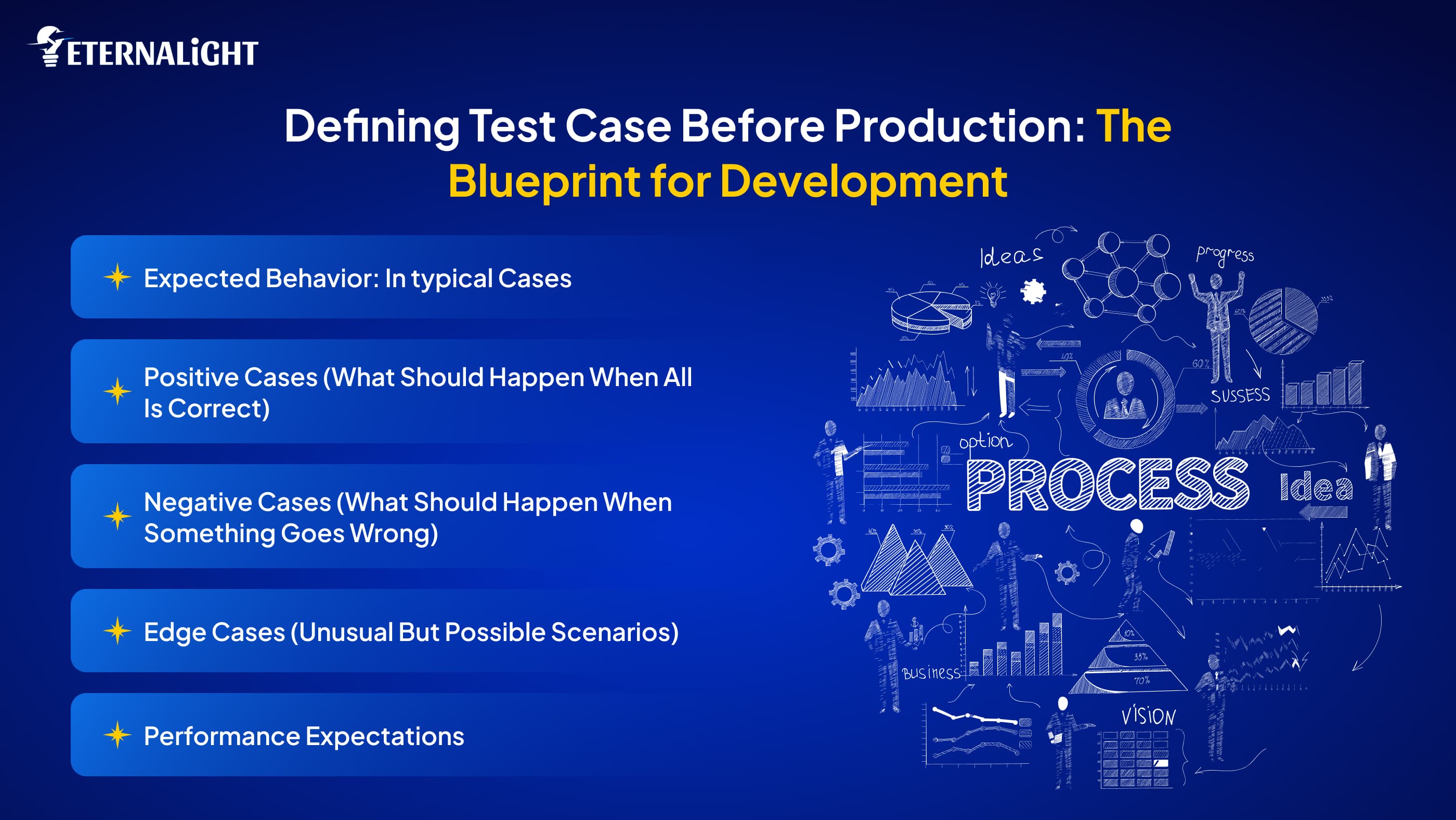
We will say developing a product is not an individual job but a team’s collaborative efforts. Where the product manager, UI/ UX designers/developers/QA, and marketing team work towards achieving the goal.
Before writing code, define test cases based on requirements and user journeys. This includes:
Expected Behavior: In Typical Cases
Items added to the cart update the count automatically
If the user logs in, the cart will persist across sessions.
Positive Cases (What Should Happen When All Is Correct)
- Inputs are valid
- User Flow is smooth
- Network is stable
- When the content is loading, its indicators
Negative Cases (What Should Happen When Something Goes Wrong)
- If the inputs are invalid
- If the API doesn’t respond
- If the access is denied due to unauthorized attempt
Edge Cases (Unusual But Possible Scenarios)
Something that needs to be checked frequently:
- UI validation (labels, colors, messages)
- What if the inventory is running out
- If the data is not fully synced
- If the network is not stable or poor
Performance Expectations
- Any set metric for response time
- How to manage the request if timeout
- User behaviour
Shift Left Testing Benefits While Defining Test Case Early
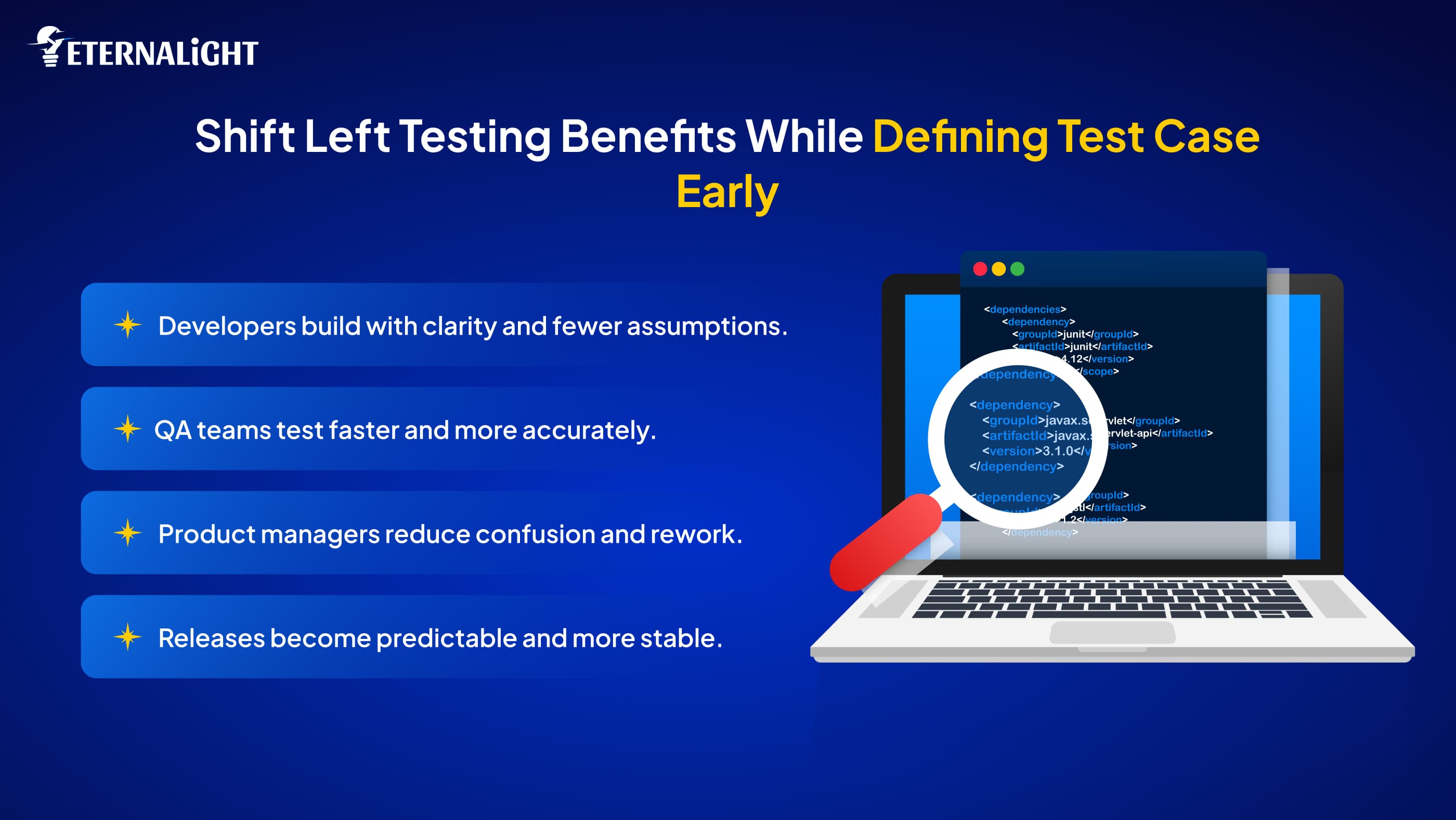
By defining test cases early, enables the successful and rapid product delivery with measurable outcomes across team:
- Developers build with clarity and fewer assumptions.
- QA teams test faster and more accurately.
- Product managers reduce confusion and rework.
- Releases become predictable and more stable.
Teams that adopted early test case planning reported:
- 40% fewer bugs
- 30% faster release cycles
- Improved trust and collaboration across teams
Will the Early Test Case Planning Sustain in the Future?
As AI and automation continue to grow, early test cases planning will become even more
critical.
Software development teams are actively exploring how all stakeholders collaborative workflows will impact outcomes, working on the same page from day one.
Automated test case generation, requirement-based testing, and API-level validation will run in parallel with development. The future belongs to teams that collaborate from the beginning: Product, QA, and Development working as one.
Beyond compliance in silos, work will start on the first day.
Wrap Up
Defining test cases before building products is not just a QA task; it’s a teamwork discipline that saves time, reduces cost, prevents failures, and builds user-friendly products.
The earlier you think about testing, the more reliable your product will be.
In a modern product development ecosystem, testing isn’t the last thing; it should be the first on the sprint from the beginning, without a second thought.
At Eternalight Infotech, we regularly review the products using shift-left testing to ensure reliability and quality.

Shyam Shukla
Sr. QA Engineer
Shyam Shukla is a Senior QA Engineer with 6+ years of experience in software testing and product quality. He advocates for early test planning and practical QA processes that help teams reduce bugs and build dependable software.
Frequently Asked Questions
It's good if we can predict the potential best and worst-case scenarios before the development process starts. With this, if required, you can change the direction and approach during the requirements gathering and design phase. Instead of waiting and watching, the shift left testing is all about being proactive and making fixes immediately, eliminating the costly fixes.
Whether it’s agile or DevOps practices, shift left testing principles are recommended. It enables us to identify potential issues even in the prototype phase, so we can make changes and save time and budget. It gets difficult to make any changes after deployment because we need validation from the entire software team, and rework disrupts the timeline and release.
It eliminates the risk of bugs, technical glitches, and additional effort, and improves communication among team members, making deployment and product release faster and fault-free.
Related Blogs
- Software Development11 Mins
Website Security Checklist: What to Check Before It's Too Late
Worried about website security? Use this practical website security checklist to spot common risks and protect your website, data, and users.
- Software Development7 Mins
From Off Track to Success: Custom Software Development Challenges to Fix Early
Custom software projects don’t always go as planned. Learn which challenges to catch early before they become costly problems for your budget, scope, and product.
- Software Development8 Mins
Product-Market Fit vs Revenue: What Should Indian Startups Chase
Product-market fit vs revenue: What should Indian startups focus on first? Explore the right metrics, customer signals, and growth priorities at each stage.