AI Agent vs Chatbot: Key Differences, Use Cases & Business Impact (2026)
&w=3840&q=75)
We all use smartphones and apps in our day-to-day lives. Whether it's taking a tour of a new feature upgrade, understanding, or interacting with a shopping app, or any other healthcare/fitness app, do you interact with a person or something abstract? As far as I can tell, it must be a bot you encounter. Am I right or wrong?
You must have heard about Gemini, Siri, or Google Assistant, or if you work with the MS suite, you may have interacted with Microsoft Copilot.
Correct!
These bots and assistants have actually made our lives simple and shared the load from human staff. Handling thousands of customers in a day isn’t a joke; it’s really hard to deal with their queries, especially when the same questions keep coming up.
With the rise of Gemini, AI agents, and chatbots, you can prioritize the essential tasks without missing the customer requirements. They all become good means of conversation digitally, but they differ from one another. In this blog, we will primarily discuss the differences between an AI agent and a chatbot.
Real Life Scenarios for a Better Understanding
Are you requesting a refund?
The chatbot will start a conversation by asking about the issue, present options to proceed to the next step, share the policies and conditions, assist step by step, and connect with a human representative to handle the customer request.
Whereas an AI agent isn’t just answering the question but verifying whether the item is eligible for refunds/returns, and checking whether the window is closed.
The agents connect with the CRM and email system to manage the process. It is just that managing with a bot isn’t possible, which is trained to do all the stuff.
What is an AI Agent?
It's the evolved form of a chatbot that amplifies the capabilities of managing multi-task workflows. These can autonomously perform and process actions, collect vast amounts of information, and verify it. These are also trained not only to generate pre-infused responses but also to adapt to inputs and data and respond with personalized insights.
Users can paste their chats, documents, or any type of data to get the output, enabling them to make faster decisions. These agents use NLP, LLMs, ML, and computer vision to align with intent.
The chatbot may also use different tools to generate responses, but the AI agent built with the default integration handles the task itself.
What is a Chatbot?
A chatbot is a combination of two terms: "chat" and "bot". A bot is a kind of programmed tool or system that can communicate. It can’t properly understand human language, but can generate responses to the questions asked. These chatbots are built using decision trees and pre-defined rules. Don’t mistake it for a conversational interface; it lacks NLP but can still be prompted to perform simple tasks.
In brief, these chatbots have limited capabilities and information because they are trained for specific, repetitive tasks. These bots can easily understand the context and respond using reliable trust.
Chatbot Evolution - From Rule-Based Bots to Agentic AI
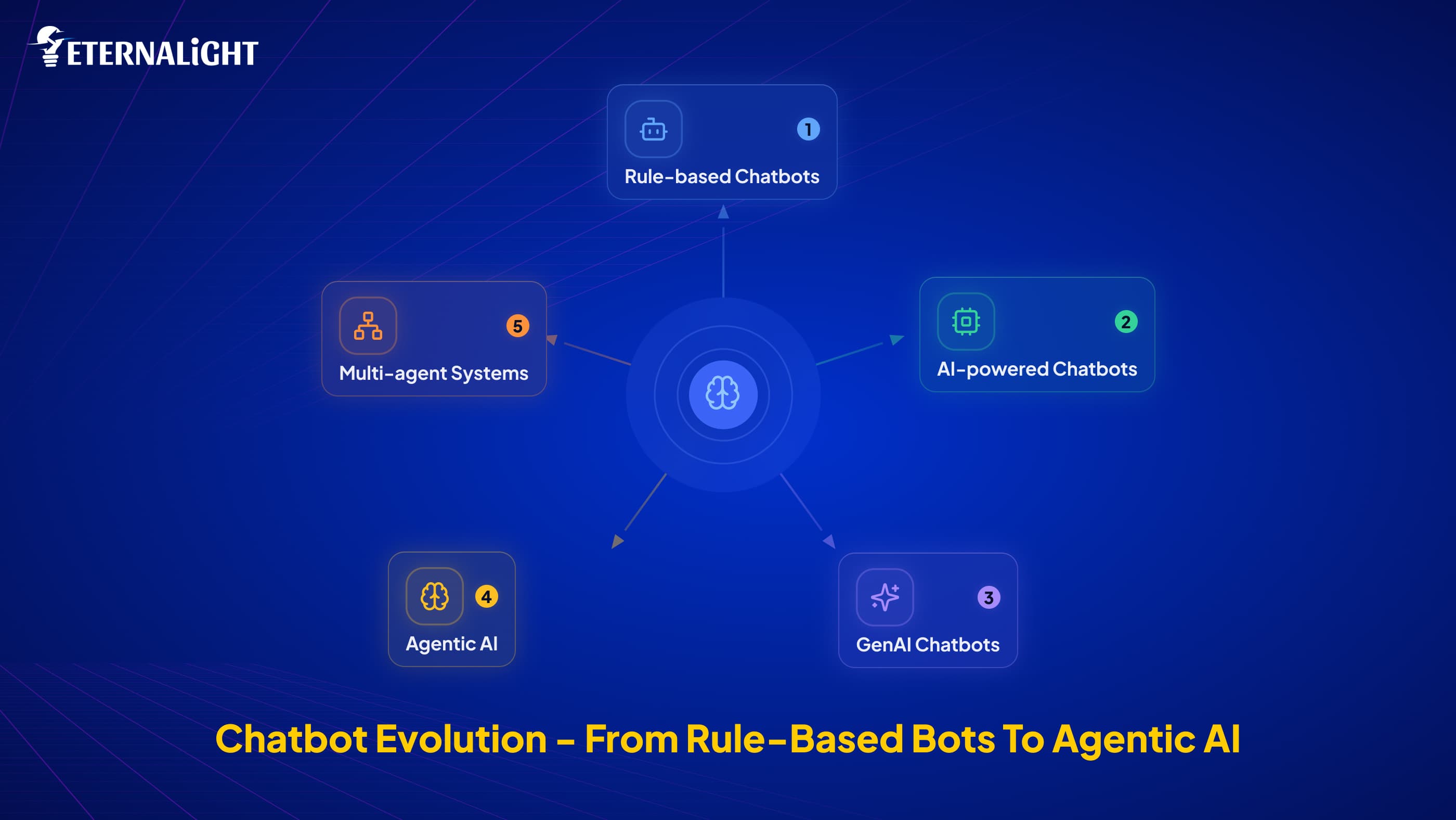
Agentic AI and chatbots can both follow voice instructions and generate responses, but over the past few years, many transformations have driven change across the tech landscape.
Rule-based Chatbots
These chatbots are developed on a decision-tree system, with true and false statements and responses generated via predefined rules and scripts. If any question doesn’t match the user query, the chatbot fails to respond.
AI-powered Chatbots
Determine the user's intent and relevant world context, and respond accordingly using NLP advancements. Used for lead generation, order requests, appointment scheduling, and customer support
GenAI Chatbots
Accessing the LLMS for AI-powered, more reliable human-like conversations for dynamic situations
Agentic AI
Reasoning, strategic decisions, and connectivity with external tools for autonomous task executions
AI Agent vs Chatbot - Key Differences
Even though we have defined each one in the paragraph above, to make it more scannable and digestible, we are highlighting the key functionalities of the AI agent and chatbot here.
Chatbots
- Chatbots are designed for a unique purpose.
- It goes with the flow of preset rules.
- It can navigate through the path to do a task. They will generate a response to customer inputs, but they don’t know what to do next.
- After a few questions, the chatbot will ask to end the conversation because it is built for a limited task.
- Limited memory space for limited accessibility
- Easy to build
- It needed direction from a human to perform the next move
AI agents
- AI agents are for multi-step execution to autonomously manage a team's tasks.
- They can retrieve, access, and utilize complex datasets in any structured or unstructured format, edit and validate them, and even inform the user via email or message.
- Based on personal experiences and context, AI agents keep the conversation going until the user's goals are met.
What Makes an AI agent different from a Chatbot?
An agent can be a chatbot, but a chatbot can’t be an agent. They are both conversational tools, but the purpose for which they are built and the mechanisms they use to execute the task vary.
A chatbot is basically for providing information when the user submits a query, matching the question to the relevant answer. In a chatbot, there is no prediction of the user's next question, but there is a set of questions, and one of them will match the query.
AI Agent path- it checks first what the final outcome needs to achieve, according to which it prepares the stack or steps- access the information, select the best agent that can perform the job action, verify and validate, and then generate the response.
When Should Businesses Use AI Agents?
Building an AI agent is a tedious job that not only assists users but also performs tasks on their behalf, eliminating manual operational chaos.
From onboarding the customer to drafting the report, executing reconciliation, and some IT execution through the CRM integration. Taking meeting notes, scheduling, follow-up, making the collaboration more flexible and sophisticated with utmost automation.
When Should Businesses Use a Chatbot?
AI agents are becoming the center of attraction across diverse business domains. It doesn’t mean that bots are no longer worth it. It all depends on the requirements and intent. If any business is introducing a new product or assisting customers with basic inquiries, booking confirmations, electricity complaints, self-ordering food, or other general tasks, it can ask an AI development company to develop a chatbot.
AI Agent Failure Scenarios Businesses Should Know
AI agents have numerous capabilities that enhance efficiency, productivity, automation, and robustness across systems, but building them isn’t easy as developers face challenges of AI development.
- If the functionality isn’t done properly then it may disrupt the workflows.
- Due to incorrect information, a user trust issue can arise, leading to incorrect responses.
- If the data is sensitive, it must have validation rules that allow further processing only after obtaining the user's consent.
- If you choose the wrong action or option, the user journey will be disrupted.
- AI agents must not be given full control of the internal system, or, if they can take serpentine action on their own, it may cause conflict.
Cost & Development Complexity Comparison
Each new integration, third-party API, and new feature comes with a cost and effort. Whether it's chatbot or AI agent development work, both need intensive research and analysis to evaluate which aligns with your business objectives.
If a chatbot is sufficient to handle the task with automation with fewer capabilities, then there is no need to waste your budget on an AI agent.
But if you work in high-level operations and need to perform tasks efficiently, saving time wasted on manual tasks, it's better to invest in an AI agent, as these are more robust, reliable, and compliant with governance. Also, it can be customized to amplify the capabilities.
Should You Build a Chatbot or an AI Agent?
It seems confusing when we want to take a call on whether to use chatbots vs AI agents. So both have advantageous aspects and what matters the most and making the difference is your intention behind launching one. If you know what questions users regularly explore or ask, and we need to give the same answers, which sounds generic as well, then go for the chatbot. It takes less time and costs less to build and optimize workflows.
On the other hand, if you have a user journey that is completed in multiple steps, where a single system or chatbot cannot handle the task. Then, launching the AI agent will deliver a personalized experience with sophisticated workflow execution.
Future of AI Agents and Conversational AI
Instead of generic questions and answers, businesses now want proper task execution using the power of AI. They want systems that can access, collect, and analyze the information and multi-format datasets. Also, these systems can collaborate with multiple AI-powered tools and assist people with their cross-functional operational workflows.
By witnessing the pace of evolution in LLMs, RAGs, memory systems, and workflow needs, we can have more innovative, advanced AI agents in the near future. But after all such transformations, the magnetic power of human intelligence cannot be sidelined.
Humans tend to frame strategies as real-world problems and think in ways that lead to making changes.
Conclusion
Trends and technologies keep evolving, and we can’t rank them because each has unique advantages that fit specific business operations better. When a business isn't handling a complex task and wants a reliable, affordable way to engage users, chatbots are a good fit. But if things go beyond the replies and involve strategic, actionable moves, integrating an AI agent is power move. Before developing an AI agent vs. chatbots, it’s better to assess users' expectations for the product, business complexities, and future growth.

Ayushi Shrivastava
Senior Content Writer
Ayushi is a Content Strategist at Eternalight Infotech with 4 years of experience in transforming complex ideas into clear, engaging, and SEO optimized narratives. She specializes in crafting impactful content strategies that enhance brand visibility and drive meaningful engagement across digital platforms.
Related Blogs
 AI & ML17 Mins
AI-Ready Data Architecture: A Complete Guide for Modern AI
Learn how AI-ready data architecture works, its key components, framework, how to build it, and how it supports generative AI, machine learning, and AI agents.
 AI & ML16 Mins
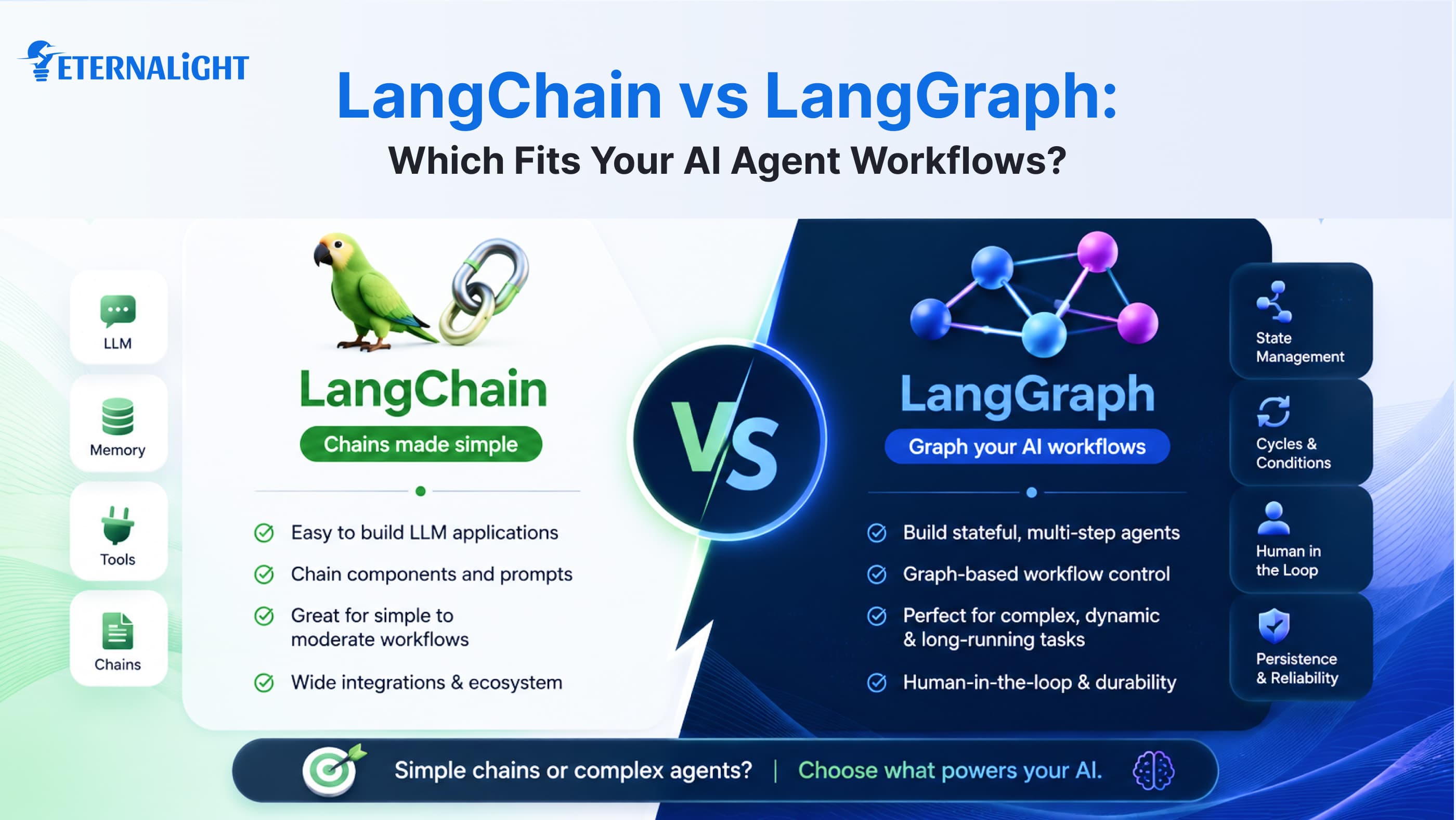
LangChain vs LangGraph: Which Fits Your AI Agent Workflows?
Compare LangChain vs LangGraph to understand their key differences, use cases, and how each framework fits modern AI agent workflows.
- AI & ML9 Mins
Comparison of n8n vs LangGraph: Which Fits Your Project
Compare n8n vs LangGraph to understand their strengths, use cases, AI agent capabilities, scalability, and governance, and choose the right fit for your project.