&w=3840&q=75)
Doesn't the number matter?
It determines whether you’re on the right track.
What are you missing?
What is impacting SaaS growth, and what is increasing value and revenue?
If we don’t evaluate and track the no on a timely basis, it will be hard to decide which balls fall in the right place and which need redirection. In this blog, we discuss the pain points of a SaaS product development company: they struggle when they don’t track the right metrics.
What Are SaaS Metrics?
When a company launches an app, they offer some features for free, while premium features are available only on a specific plan. Some users can buy the plan during a free trial or continue later, while others may leave midway after 1 or 2 subscriptions or end the service just after the trial.
Understanding customer behavior, engagement, acquisition, and retention is essential for an efficient SaaS business, and it relies on key SaaS metrics to estimate sustainable growth. Some businesses can generate profit on the first purchase, but others may need to keep engaging customers with offers and flexible subscription plans to cover acquisition costs and generate revenue.
In brief, SaaS metrics are business indicators used to evaluate product performance, growth, and revenue, and to align with customer interests and behavior. After collecting the insights, business founders can strategize and take action for long-term endeavors.
Real World Picture B2B Saas Product Metrics
For instance, a marketing team needs to track website traffic, visibility, and search engine optimization across the web; to do so, they use GA4, GSC, and SEO platform tools. It reflects the technical and non-technical information needed to understand the insights and plan strategies based on them.
In a SaaS company, the business focuses not only on the website or apps but also on various metrics to go beyond them. They talk about financial flow/revenue and customer engagement, so generally their discussion tables deal with the answers:
- How much are they spending?
- How much are they generating on a quarterly or annual basis?
- How much does it take to engage a customer and keep in touch?
- Are we working efficiently on the product and delivering on time?
- We can’t assume all these things.
5 Pillar SaaS Metrics: Which Matters at Different Growth Stages
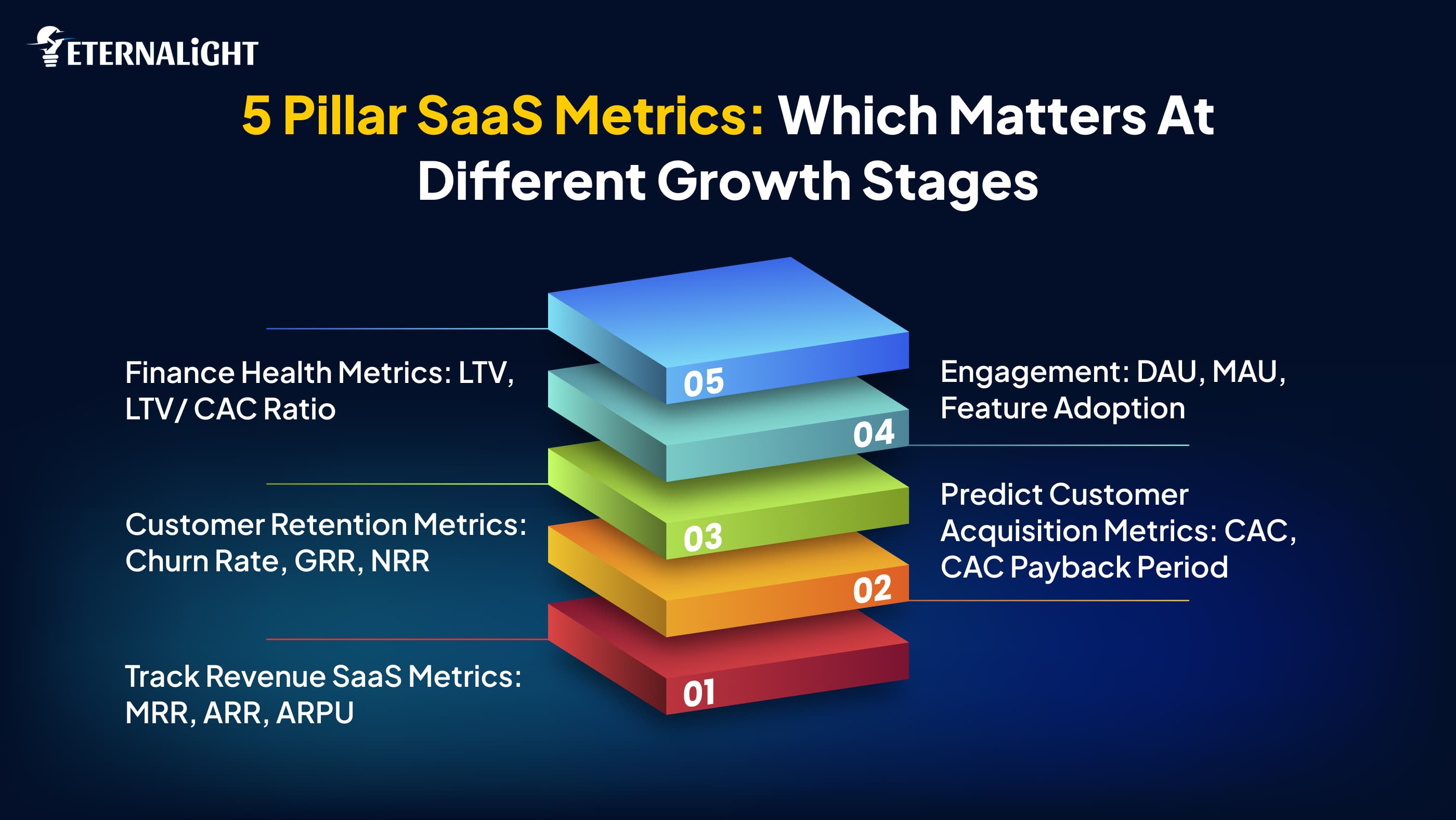
If any startup is at any infant stage, their struggles and priorities will be different, but when they’re trying to gear up and scale the business, then they need to think about the stability, future initiatives from every point of view so that their funding will stay secure, their loyal customers stay loyal and new engagement is initiated without interrupting operations, setting up the strong brand reputation. At different levels, founders need to focus on different things and think.
So, if you say briefly about the SaaS framework and the role of metrics, most CFOs, CTOs, and founders look for growth, customer engagement & retention, gross margins, financial health, and efficiency.
Track Revenue SaaS Metrics: MRR, ARR, ARPU
Predict Customer Acquisition Metrics: CAC, CAC Payback Period
Customer Retention Metrics: Churn rate, GRR, NRR
Engagement: DAU, MAU, Feature Adoption
Finance Health Metrics: LTV, LTV/ CAC Ratio
This section covers the indicators and key saas metrics you need to remember and monitor at various stages to unlock the growth potential.
Which SaaS Metrics Matter at Different Growth Stages?
We have divided the essential SaaS business metrics into 4 different categories. Explore them one by one:
Infant Stage Before Product Launch
Reflect on your business predictions and services and ask a few questions:
- Can your product satisfy the real problem with the core features?
- Which features do they frequently explore daily?
- After signing up for a form to try an app, do they explore the features and ask for a subscription, or do they stay engaged for a long time?
- When you conducted the survey, did they recommend and share their feedback?
If these questions are on your mind, you must be figuring out whether your MVP product is a good fit or needs an upgrade. How many of them?
If your answer is yes, you’re on the right track. Still, to gain clarity, you should monitor the Activation rate, feature adoption rate, daily active users, monthly active users, and net promoter score.
After the MVP release
Moving on to the next stage, if your product is a good fit, check how frequently and how quickly users interact with it and generate profitable returns. So notice the following things:
- Do you need to allocate a budget to acquiring customers?
- Do customers/users stay after signing up, or do they uninstall frequently?
- Do they leave after the trial version and switch to new features with a subscription?
- Are you earning a profit?
You can predict and assess growth potential using monthly recurring revenue, customer acquisition cost, trial-to-paid conversion rate, customer retention rate, and churn rate.
Scaling MVP to Advanced Level SaaS Product
Now, if your MVP is performing well, you will consider expanding your business to make it more profitable and efficient, scaling with advanced features to capture customer attention. Investors, founders, and all stakeholders look for grounds to establish greater economic value. If you see the potential to boost sustainability, customer acquisition, and engagement, companies will definitely grow.
At this stage, when you are planning to scale from prototype to product, look for enterprise SaaS metrics such as annual recurring revenue, customer lifetime value, net revenue retention, expansion revenue, and LTV ratio.
After Becoming a Known Enterprise-grade SaaS Product Development
Is your business established, and do you have a loyal base of customers who frequently explore your apps and are impressed by your launches?
It's time to think beyond just spending and launching and try to strengthen and secure what you already have.
Where do you see your business in the coming years in terms of growth, new partnerships, contracts, and operational efficiency?
All these things can be evaluated via gross revenue metrics, net revenue retention, renewal rate, gross margin, and ARR forecasts.
How Product Owners Should Review Metrics
This is not a headache but a common practice you need to adopt to run your SaaS business smoothly. You don't need to do it all at one go, just think strategically.
What can you track daily?
- How many people visit your app or website daily?
- Which features are widely completed in the user journey?
- Are there any issues users are facing?
Help you understand the trend of customer behavior
What should you do on a weekly basis?
- How many people switched from trial to paid?
- How many have tried the new features?
- Do they leave any positive or negative feedback?
- What trends should you leverage?
Help you understand adoption & engagement
What do you need to track at the end of the month as a monthly report?
- Check MRR or monthly recurring revenue
- Churn rate: how many customers have discontinued
- Also, check retention and NRR value
Track which action or move was right, which went wrong
Where do you need to think after every three months?
- Has revenue expanded or been cut off?
- For how long has the customer been staying?
- Estimate the ARR value
Evaluate your profit and product growth based on the previous initiatives and decisions for the quarter, and assess whether they align with the milestones and objectives.
14 SaaS Metrics That Matter Most for Measuring Growth
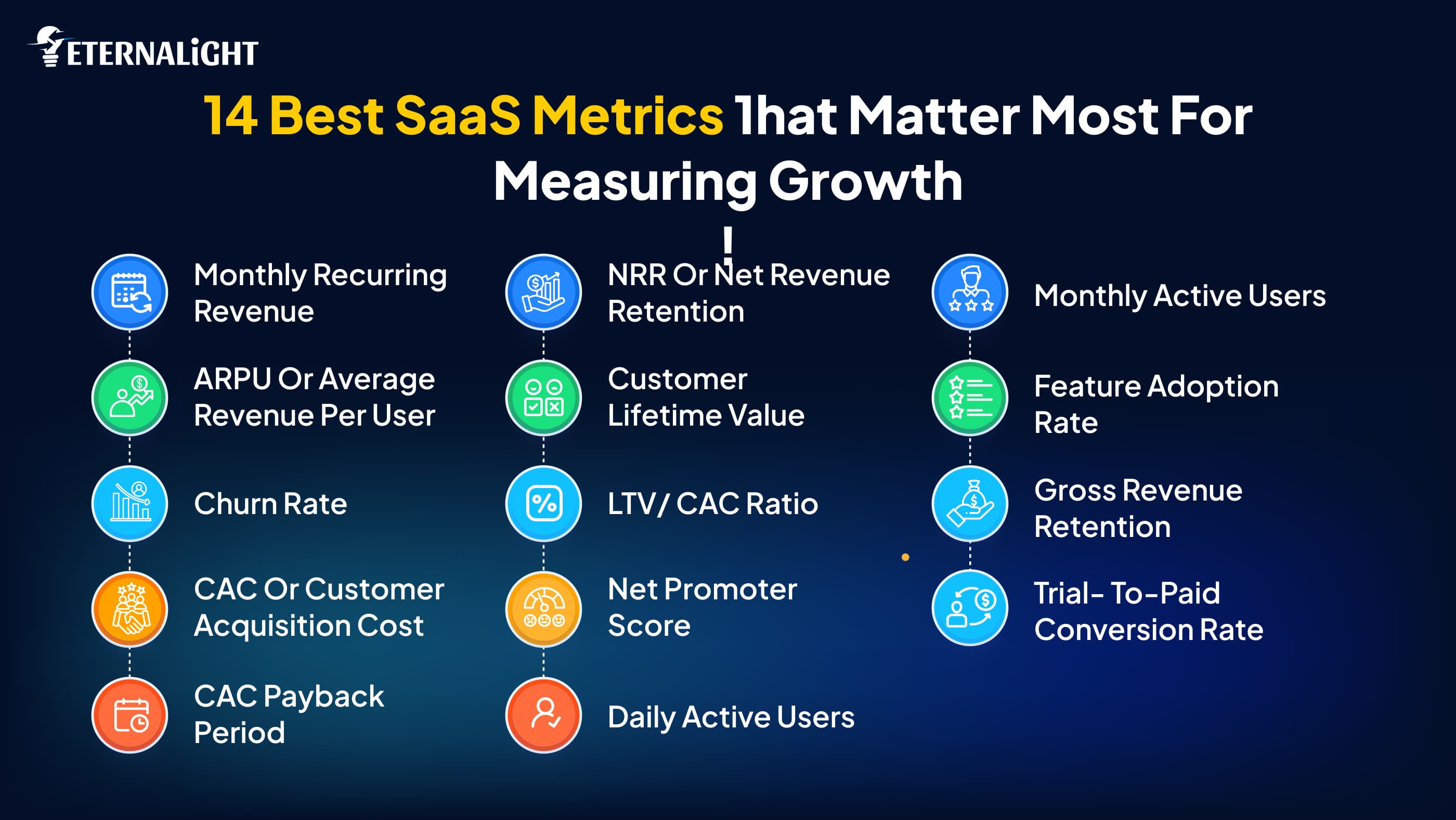
Business doesn’t drive on assumptions. We can’t always be blind to assumptions. Insights clarify that the intent is working fine. To achieve consistent, sustainable growth, metrics play an important role in SaaS product development.
Here are the 14 best SaaS metrics every founder should be aware of, which serve as pillars of growth. They also help to avoid costly mistakes.
Monthly Recurring Revenue
If your business offers a monthly subscription plan for a specific service, the income generated at the end of the month will be considered Monthly Recurring Revenue. Prices may vary depending on the plan, selected services, offers, and other terms and conditions. If you miss it, how can you predict whether that model can work for you? Don't you think?
MRR is one of the most significant SaaS metrics to track for stability, sales, and budget, as it can predict average month-to-month growth.
It's not that difficult to measure MRR; you just need to calculate.
MRR = Total Revenue from All Subscribers/ Number of Active Subscribers.
Remember that it’s not the total revenue; it varies depending on subscription-based services.
To calculate total annual recurring revenue, multiply the MRR output by 12. While investors ask for the numbers, they usually ask for annual revenue to assess whether your business has enough potential to scale and how your service model benefits customers.
If you want to differentiate how much revenue you generated from new customers versus how much you got from existing subscribers/users. Then categorize them for clarity, as some may cancel the plan or upgrade to premium services.
ARPU or Average Revenue Per User
Find out how much your subscription plan is generating from active customers, and unlock new avenues to increase profits. With this ARPU metric, you can identify the high-value customers who drive your business growth.
Calculate the ARPU = Total Revenue/ Total Active Customers
Churn Rate
We can neglect any factor but not this one. Businesses track this percentage to understand how much revenue is generated in specific periods by a significant number of customers, whether customers have uninstalled the app or canceled subscriptions, and how that has impacted the business.
Churn rate is calculated to track changes in customer count, revenue loss, or other recurring revenue.
Suppose that you have 100 loyal customers in the first month, and by the end of the month, you have 90 left, so you need to apply this formula:
Churn Rate= (Customers Lost/ Customers at Start) x 100
The same thing is with revenue churn rate, where you monitor the change in recurring revenue per month, for which the formula is
Revenue Churn Rate=(Previous Revenue-Current Revenue) / Previous Revenue x 100
CAC or Customer Acquisition Cost
How will you reach out to customers, either with a call/ message, exciting offers, or rewards? In every case, you’re spending something. For this, you need to appoint a dedicated professional, so you have to pay a salary and provide them with some tools and resources. All these things can be done with money. The overall spending is considered the customer acquisition cost.
CAC = Total Sales & Marketing Cost/ Total New Customers Added
CAC Payback period
You can’t recoup the cost of customer acquisition in a day; it takes time to earn their trust and profit from them, making them loyal customers. This metric evaluates how many months of time you have earned that amount, which generates the profit that covers the cost. If you have coverage within a quarter, it's fast cash flow from your subscription plan services. To evaluate the CAC payback period, do as follows:
CAC= (Sales & Marketing Costs) / New MRR x Gross Margin %
NRR or Net Revenue Retention
Neither the customer joined nor did they leave, but if you want to calculate revenue from the existing customer base, it's Net Revenue Retention.
((MRR in Starting + MRR in Expansion - Churned MRR - Contraction MRR) / Starting MRR)x100
Customer Lifetime Value
These are the crucial SAS metrics for determining the financial situation of any business. From the day of acquisition through the last purchase or subscription to any services, the profit generated by customer engagement is calculated as CLTV (Customer Lifetime Value) or LTV (Lifetime Value).
Using this data and insights, businesses can estimate future spending and retain customers through various offers. This metric plays a vital role in planning marketing costs and future business expansion, aiming to achieve long-term profits and reduce customer acquisition costs.
CLTV or LTV = (Average revenue per Account x Gross Margin)/ Churn rate
LTV/ CAC Ratio
Want to know whether your expenditure is turning into profit or loss? Evaluate the LTV/CAC ratio. For that, you must have calculated the customer's lifetime value and how much you’ve invested to engage the customer.
If the ratio is positive, it means you’re earning well; if it's in the lower range, it indicates you’re spending a lot.
Generally, the SaaS owner aims for a 3:1 ratio, meaning they earn 3 per customer.
LTV/CAC Ratio = Customer Lifetime Value (LTV)/ Customer Acquisition Cost (CAC)
Net Promoter Score
Generally, on Myntra, Nykaa, any food delivery app, or any utility app, you're asked to rate their features and services and leave feedback. They want to assess whether the user liked the services or would recommend them to someone. Users can share their experiences, give points, and contribute to the product's growth in the market. Through this, the business owner can identify loyal customers who are highly satisfied, as well as those who are not satisfied with the products or services.
People who frequently recommend your products or services with higher points are promoters who are satisfied, but on average, they are passive and share negative comments or have a poor experience, and are called detractors.
To identify whether the product is top-notch, performant, or failed to impress the customers, the count shows all. To get an exact count, do as follows:
NPS = Get Total Percentage of Promoters- Total Percentage of Detractors
If you have conducted the survey over 1000 customers/ users in which 500( 50%) are promoters, 300 are passive(30%), and 200(20%) are detractors, then,
NPS would be 50%-20%= 30%
Daily Active Users
No matter how many new customers or users get engaged, having a track record of people who actually love your product and use specific service features daily is valuable.
It lets you see whether the app is getting high traffic volume or not being downloaded by users, which means you need to make some upgrades to make it more impressive and boost user engagement.
DAU = Number of Unique Active Users in One Day
Monthly Active Users
Let's assume you have set the rule to post on YouTube for 30 days. Each day, some new members view your content, while others have been watching since the first day and continue to follow. Now, to get the total count of monthly users actively watching your content, use the metric Monthly Active Users. Similarly, if there is an app that users use to see how many users are engaged, how many have downloaded/ installed it, and how many keep exploring it, you can track the MAU.
MAU = Number of Unique Active Users in a Month
Feature Adoption Rate
An app has multiple features to serve various purposes, and each user explores them according to their needs. It's worth tracking which feature is getting more traction. By tracking this metric, you can remove unnecessary features and develop new ones for better acquisition and adoption.
To calculate this metric:
Feature Adoption Formula = (Features Used by User/ Total Active Users)x 100
Gross Revenue Retention
Neither is the product upgrading, nor are you noticing any further changes, but you want to measure the value of the existing feature in engaging and retaining users over the long term. This SaaS metric enables the calculation of recurring revenue. To calculate this:
GRR= ((Starting Revenue - Churned Revenue - Downgraded Revenue )/ Starting Revenue) x 100
Trial- to-Paid Conversion Rate
Remember when Jio launched the SIM for free with a monthly internet pack. After a few months, they launched a different plan for OTT usage, cricket pack, and other services. Many customers have stayed with them even after these recharge packs; the reasons are their modesty and fast internet speeds across major urban and rural areas. To evaluate how many users switched from free to paid subscription, the conversion rate formula is here:
Trial-to-Paid Conversion Rate = (Paid users / Trial Users)x 100
Common SaaS Metrics Mistakes
SaaS metrics or KPI are essential for tracking whether you’re investing your time in the right direction. Check if you’re doing it right.
- If any business metrics don’t align with your product or objectives, they're not worth tracking. Track the data and insights that are favorable for your business.
- If you could consistently track 10 to 15 core essential SaaS metrics and monitor them in a timely manner, your SaaS-based product development company would be in a good position.
- Do you miss tracking customer count, gross margin, or NRR? Pay attention if you want to achieve success. Otherwise, it impacts revenue and growth.
- Don’t mistake higher profit for sustainability. Focus on product improvement to make it accessible to a wide customer base. If your product exceeds the user's expectations, profitability will follow automatically.
- You can’t achieve anything without taking action; preparing the reports or tracking the metrics isn’t enough. Review them over time to understand the customer expectations and DNA experience.
SaaS Metrics Dashboard Checklist
Let's go straight to the short way to scan what you should do and how the above-mentioned SaaS metrics will measure growth.
Your dashboard must include sections for revenue, acquisition, retention, product overview, and strategic initiatives. Tick if the following questions are satisfied:
- Any changes in revenue?
- Will the revenue increase in the future?
- Do you pay more to acquire a customer?
- Can you recover this acquisition cost faster?
- Is this product delivering value?
- Are customers adopting it or engaging with existing and new features?
- Are the customers becoming valuable, loyal customers?
In this blog, we have shared the 12 essential business metrics that help you dig deeper into SaaS business growth and indicate where you stand now and how far you have to go. Also, you can read more on common challenges that a founder gets to freak out during their startup operations.
Final Words
A SaaS software development company doesn’t become successful by making heavy promises or adopting emerging trends; it depends on customers' and users' opinions and engagement with its products and services. Even if you follow and monitor SaaS metrics, failing to understand your customers' needs and align them with your product’s core values won’t drive growth. First, the business should focus on
adoption > engagement > acquisition efficiency> retention, customer value > profit.
The more time you spend researching the market and customer behavior, the more your decision-making power will mature, and so will your business reputation.

Ayushi Shrivastava
Senior Content Writer
Ayushi is a Content Strategist at Eternalight Infotech with 4 years of experience in transforming complex ideas into clear, engaging, and SEO optimized narratives. She specializes in crafting impactful content strategies that enhance brand visibility and drive meaningful engagement across digital platforms.
Frequently Asked Questions
A B2B SaaS product development company prioritizes only the metrics that drive revenue and strengthen the financial condition. Focusing on first response time, ticket volume or subscription volume, SLA compliance, and customer satisfaction score will add value.
DAU and feature adoption rate only need daily or weekly observation. But when we talk about the financial key SaaS metrics, churn rate, MRR, ARR, and NRR need to be reviewed by the end of the month and quarter. This frequency will reduce frustration and make it easier to refine the strategy.
Until you have data and insights into how customers interact with your product, how will you know whether the product has market fit or needs improvement for a better experience? What users don't like? Business doesn’t depend only on assumptions; we must have numbers: how much you spend on acquisition and retention, and this will make the best actionable plan.
Related Blogs
 Software Development9 Mins
Why Choose Python for Fintech App Development?
Learn how Python helps fintech businesses build scalable, data-driven applications with powerful support for analytics, AI, APIs, and automation.
- Software Development8 Mins
Is It Time to Build Off the Self vs Custom Software for Your Business?
When should you build custom software? Learn the key signs, costs, limitations, and factors to consider before choosing custom software for your business.
- Software Development11 Mins
Website Security Checklist: What to Check Before It's Too Late
Worried about website security? Use this practical website security checklist to spot common risks and protect your website, data, and users.