What can stop the organization's growth?
Some people will raise concerns about market dynamics, the organization of unstructured data, and false insights.
Others will say procrastination and discrimination within the cross-functional team lead to poor communication and project delays.
Still, you didn’t raise the major concern, which is AI security risk: cyberattacks that make the system vulnerable and hard to respond to.
A single AI-driven data breach can destroy millions and cause reputational damage. The blog highlights the same concern: why founders should pay attention to AI security risks and how to reduce this problem.
Real-Life AI Security Threat Events, Reports & Stats
If you have time in your busy schedule one day to explore your PC, do it and check how many AI tools and extensions you have installed.
It could be for lifestyle, project management, daily planner, budget planner, transactions, or other things.
The numbers will definitely shock you. How insane it is that we actually rely 70%-80 % on these tools.
We easily fall for their brighter version and forget the dark side that it can also encroach on our security, stealing confidential data.
In public places, when using phones or systems, we worry that people sitting near us won’t see what's on screen; we often try to hide it.
So many tools have emerged in the industry that have created chaos, vanishing people's social image.
- You must have heard about deepfake videos where people manipulate the images, voices, or expressions of influential people and post them online. The technology can make fake content appear highly realistic, creating risks such as impersonation, misinformation, financial fraud, and phishing.
- DARPA has also researched technologies to detect, attribute, and characterize AI-generated and manipulated media. This was quite common during 2024 to 2025, which led to vulnerabilities and real-time financial fraud and phishing attempts.
This risk is becoming more hazardous and unpredictable, influencing people’s sentiments.
- At the end of 2025 and the first quarter of 2026, during December to February, AI-driven or Gen AI-powered tools Claude and ChatGPT 4.1 have influenced Mexican federal agencies and have had a wide impact on taxpayer records.
- Another event we would like to mention is about the Hugging Face platform; it's an open community where people can discuss, share their ideas and opinions, host and test their AI models and datasets, and also enable users to do demos. The model has a vast library to manage different tasks in different formats: text, audio, video, or image.
- In July 2026, Hugging Face disclosed an intrusion into part of its production infrastructure driven by an autonomous AI agent. The company reported unauthorized access to a limited set of internal datasets and service credentials. Its later technical report described an approximately 2.5-day intrusion involving an autonomous AI agent and third-party infrastructure.
- In July 2025, China-linked threat actors exploited vulnerabilities in on-premises Microsoft SharePoint Server, targeting internet-facing organizations and attempting to gain access to their networks.
- Zoomcar, an automobile car-sharing company, also suffered a similar data breach in which the data privacy of 8.4 million users was compromised; however, it didn’t affect financial records or transaction history, but registration no. and other personal profile details were exposed.
- In October 2024, Russian hackers tried to steal users' credentials by disguising themselves as Amazon and Microsoft.
- You may have heard about the 2024 Snowflake customer-account campaign, in which attackers used stolen credentials to access customer environments. Organizations including Santander and AT&T were among those affected. The incidents highlighted the importance of strong identity security and multi-factor authentication.
- In July 2026, reports emerged alleging that approximately 700 GB to 1 TB of Bank of Baroda customer and internal data had been exposed online. The bank stated that the reported incident involved a compromised employee email account and that its core banking systems remained secure while a forensic investigation was underway.
Now the RBI and banks must develop a robust, AI-powered system to avoid such events. SISA and CERT-in, a global AI-driven cybersecurity firm, have previously informed about this threat.
According to a recent 2026 IBM report, exploitation of public-facing applications increased by 44% compared with the previous year, highlighting the growing importance of securing internet-facing systems.
In another Accenture study, 77% of organizations experienced data and security breaches. These incidents highlight the need for stronger security controls, governance, and protection across the technology infrastructure.
But the sad thing is that we had no preparation to handle such events until this threatened our organization's legacy, and the organization didn’t have time to reflect on this.
Now, the biggest issue is not who circulated these AI security threats, but whether the founders have a proper plan to deal with this difficult situation in advance.
Conventional Governance Framework to Deal With Security Risk
Initially, leaders strategize to address business problems, with major concerns about unpredictable demand, market dynamics, natural disasters, or complexity. But now the world has evolved.
Having the prep isn’t enough anymore because you don’t know what kind of threat can occur. It's an AI-driven world where automation, efficiency, and unpredictability are at the top of everything, making leaders feel anxious.
A small piece of malware spread at an exponential rate and destroyed millions of systems in a minute. TNT Express has reported an incident in which 40,000 systems and 10,000 servers were affected within 40 minutes.
We have so many options to achieve our goals, but the information we have is not enough or accurate. Founders need to be very mindful before taking any action; otherwise, the situation can worsen.
Another thing is that traditional security practices don’t work: people have grown accustomed to alerts, so if anything has to happen, it won’t be a sudden blast; we must have some alerts beforehand. But it didn’t, as we have mentioned earlier in this post about the password email credential hack; you can assume how it can damage the entire banking management.
Adaptable Framework to Deal with Cyberattacks and AI-driven Risks

Recently, we have noticed that people are using Claude, OpenAI, and other tools to seek assistance with numerous tasks, such as management, code snippets, project planning, and more, as well as legal research, but they are unable to generate responses until you explicitly explain the situation, role, purpose, or work.
Even with continuous prompts, these tools still get confused. AI tools drive readiness but lack accuracy. AI tools can introduce privacy risks when employees submit confidential information without understanding how the tool handles, retains, or processes that data. Founders should therefore define which information can be entered into AI systems and which tools are approved for business use.
AI tools enable efficient workflow management, but they also stem dependency and fragility. To avoid any tension and anxiousness, founders have a 4-step new approach.’
Assumption
Understand user behavior; stay updated on real-life incidents, and assume what can threaten the system and what the provocative step is to recover.
Cultivate
Understandably, employees can make mistakes while using AI tools, so it's the founders' responsibility to build a security-first culture so employees can work confidently, learning key concepts and practices from awareness programs and certifications.
Tie
AI security is not an isolated practice; it’s an essential integration that should be done responsibly to optimize workflow and enable proactive decisions.
Strong Governance
As the organization scales with evolving trends and new AI project systems, security shouldn’t be compromised. Defining transparent AI governance policies with robust access control and real-time continuous monitoring is necessary.
When Should Founders Care About Security Threats?
To determine whether the founders need to consider redefining their security and compliance strategy, evaluate the following situations. If all of them answer positively, then run the adrenaline rush; it's definitely time.
- If you keep your AI-driven customer support systems and chatbots, hold for 2 to 4 days, and adapt manual processes, will you be able to manage it efficiently without any hassle with an established setup?
- Do your professionals have technical knowledge of the system's architecture and mechanisms?
- In case the system fails, can they predict potential flags and failures that put the system on hold?
Nowadays, Accenture, Infosys, and other startups have made it mandatory for employees to complete certain training and certifications to be ready for evolving changes in the industry. However, 1- to 2-hour webinars and online certifications are not enough; are they well-trained to navigate such a scenario?
An unresponsive dashboard is a common issue across organizations. Suppose that if it happens midway through a meeting, can your management team make a mindful decision without taking AI model assistance and data insights?
AI systems and tools widely used by professionals. It may drive efficiency and reduce the burden of repetitive work, but do you realize that it is making you wiser or restricting you from using your brain?
Don’t be mistaken that AI security prevention is only an obligation for IT domain founders; it's for all, because nowadays all industry domains and organizations are heavily relying on AI-driven tools. If founders do not prepare for AI security threats or risks, it would get difficult to sustain and fight back in such an AI-driven cyber attack situation.
Common Mistakes: When Founders Go Wrong
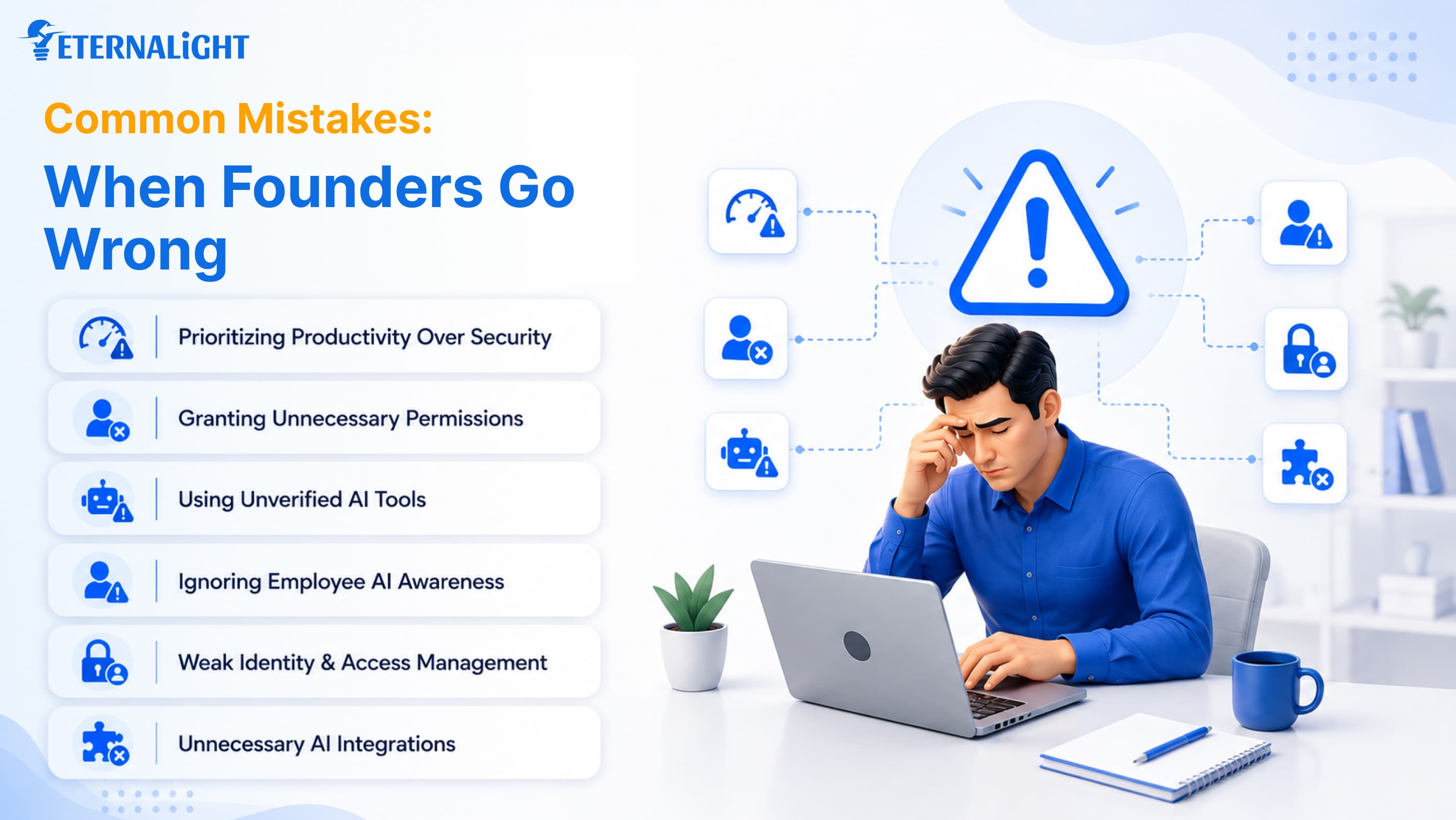
Prioritizing Productivity Over Security
Whenever we are accessing any tools, we focus on one thing: that it will get our job done in a few minutes, and we don’t need to use our brains.
But we never think about whether the AI tools we have installed are secure. When you give them inputs, and they scan to send you reminders, prepare notes, write code for your systems, alert you about your salary, or plan your monthly budget, they don’t peek into your identity and security.
Granting Unnecessary Permissions
In an organization, to use any tool, management has an annual budget, and when it reaches the limit, the tool will be removed from access. Only management knows about this; the entire team is not informed in advance that tools don't have unlimited access, and the employees will use them responsibly.
We accidentally gave permission control to these tools in a rush or out of excitement without properly understanding the policies.
Using Unverified AI Tools
Open-source tools and platforms are free and easily available for public access, but we don't know whether all the libraries and links are verified and reliable.
Ignoring Employee AI Awareness
Employees are not trained to use such AI tools, which puts additional financial strain on founders and can exceed the budget. They don’t have information about which tools are verified.
Some organizations prepare a list of verified authorized tools and software and circulate the documentation list across team members; they often schedule calls to check which tools employees are using to avoid any unauthorized access and security risk.
Weak Identity & Access Management
If management shares common credentials for any software, there is a higher chance of credential theft. Suppose anyone accidentally uses that email to use any AI tools like ChatGPT; they can get access to all conversations API.
If the password is not strong or doesn’t have 2-step or multi-factor authentication, it can lead to malicious theft events.
Unnecessary AI Integrations
Unnecessary integrations or AI models without verified sources can slip directly into the hands of AI attackers.
Restrict access to admin and database data files. If we give complete control, including the database, attackers can influence the data and trigger suspicious events
Biggest AI Security Threats that a Founder Must Be Aware of
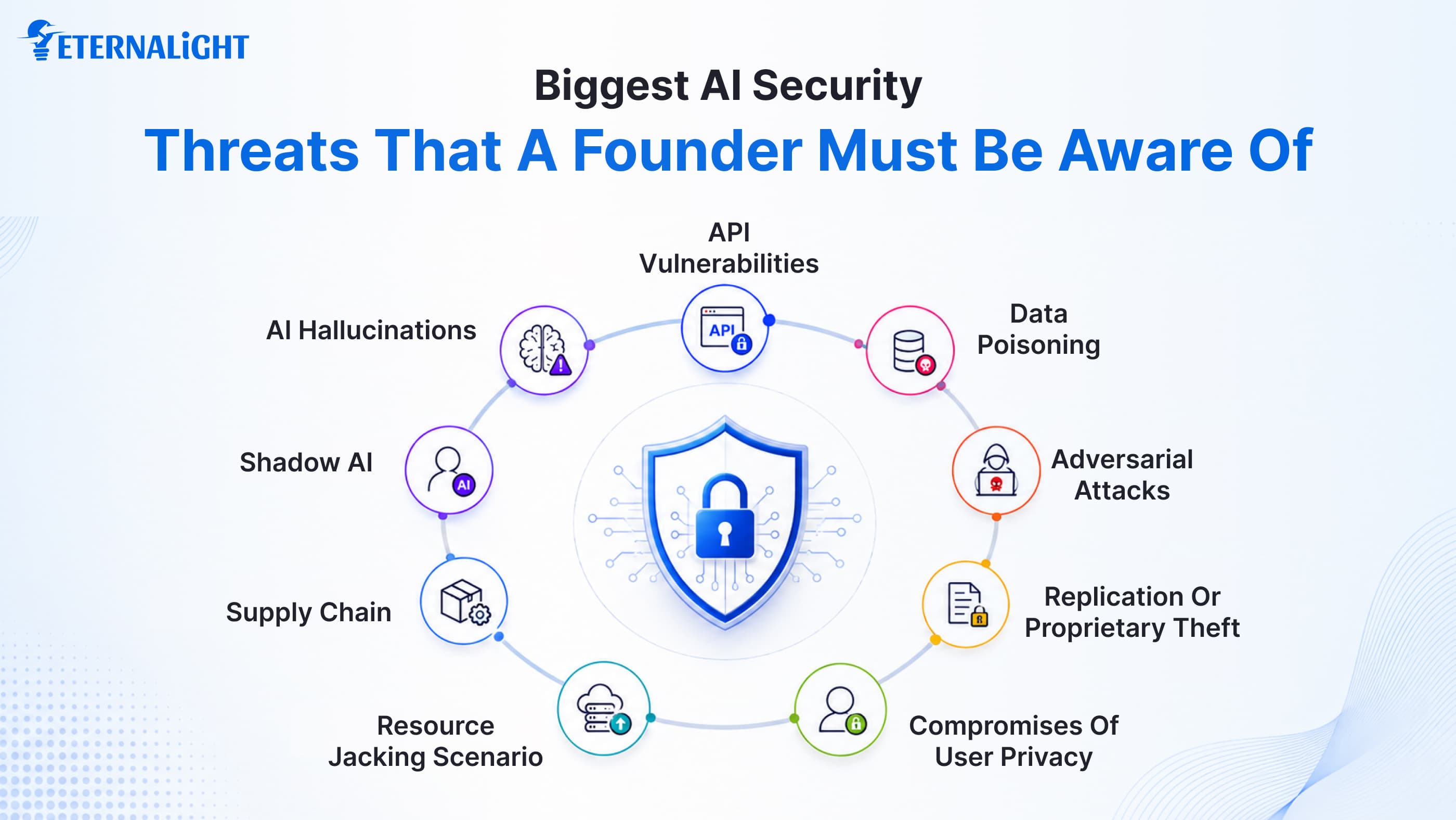
AI is capable of numerous things more efficiently than humans, but a slight change in configuration or exposure of data can open attack paths. This happens when AI integration isn’t done carefully, leading to non-compliance with security practices and standards. Here, this section explains different AI security threats.
API Vulnerabilities
APIs are connecting points to manage front-end and back-end workflows seamlessly. Without robust authentication & authorization, APIs can be impacted by AI attackers; entire systems can be hijacked and targeted through injection attacks and data theft.
Data Poisoning
While AI systems train on a data pipeline, attackers can inject malicious data packets, compromising the quality and accuracy of the information. This can put the system at risk, creating crucial vulnerabilities and impacting predictions. Thus, to avoid such scenarios, regular monitoring, validation, and exploring diverse datasets are mandatory.
Adversarial Attacks
Suppose you have given a prompt, but AI systems change it on their own and generate wrong responses, influencing your moves. If an AI system does it in healthcare, manufacturing, or vehicles, it's a serious issue; thus, companies should be careful with adversarial training and robust preprocessing mechanisms.
Replication or Proprietary Theft
AI attackers have expanded their knowledge and are applying reverse engineering to extract the AI model components that influence APIs. They can deliberately replicate the models and steal IP. It is only protected by secure authentication & authorization practices, encryption, and constant monitoring.
Compromises of User Privacy
When developing AI solutions, user privacy and secure data transmission are key concerns. Unintentionally, the AI system may expose confidential information; thus, it requires robust data governance and compliance regulations such as GDPR.
Resource Jacking Scenario
Do you know that infrastructure access can expose you to unauthorized access?
Yes, AI attackers can cause unnecessary operational expenses and workflow disruption.
Supply Chain
AI systems are not fully autonomous; they often rely on numerous third-party tools and integrations to perform multi-step tasks and take on different roles. If the entities and tools are not configured properly, they expose backdoors and vulnerabilities, and malicious events can corrupt AI systems.
They can twist the system’s behavior patterns even if they’re open-source and have public repositories; it can lead to injection attacks.
Shadow AI
According to a 2025 Gartner survey, more than 60% of employees at organizations use unauthorized public generative AI tools such as ChatGPT, Claude, and Perplexity. If they paste confidential information into these tools, AI attackers can likely hit the systems, exposing proprietary code and documents.
When any AI tool is accessed without complying with standard governance rules and from unauthorized sources, that is categorized as Shadow AI.
AI Hallucinations
This happens when users replicate or create fake content to spread misconceptions and misinformation.
Developers can develop and train the models, but it's quite unpredictable what the system will generate as output. These models may be biased and twist the output through inconsistent prompts.
This can put the system's security at risk, leading to confusion and the installation of malicious software that doesn’t belong to verified repositories.
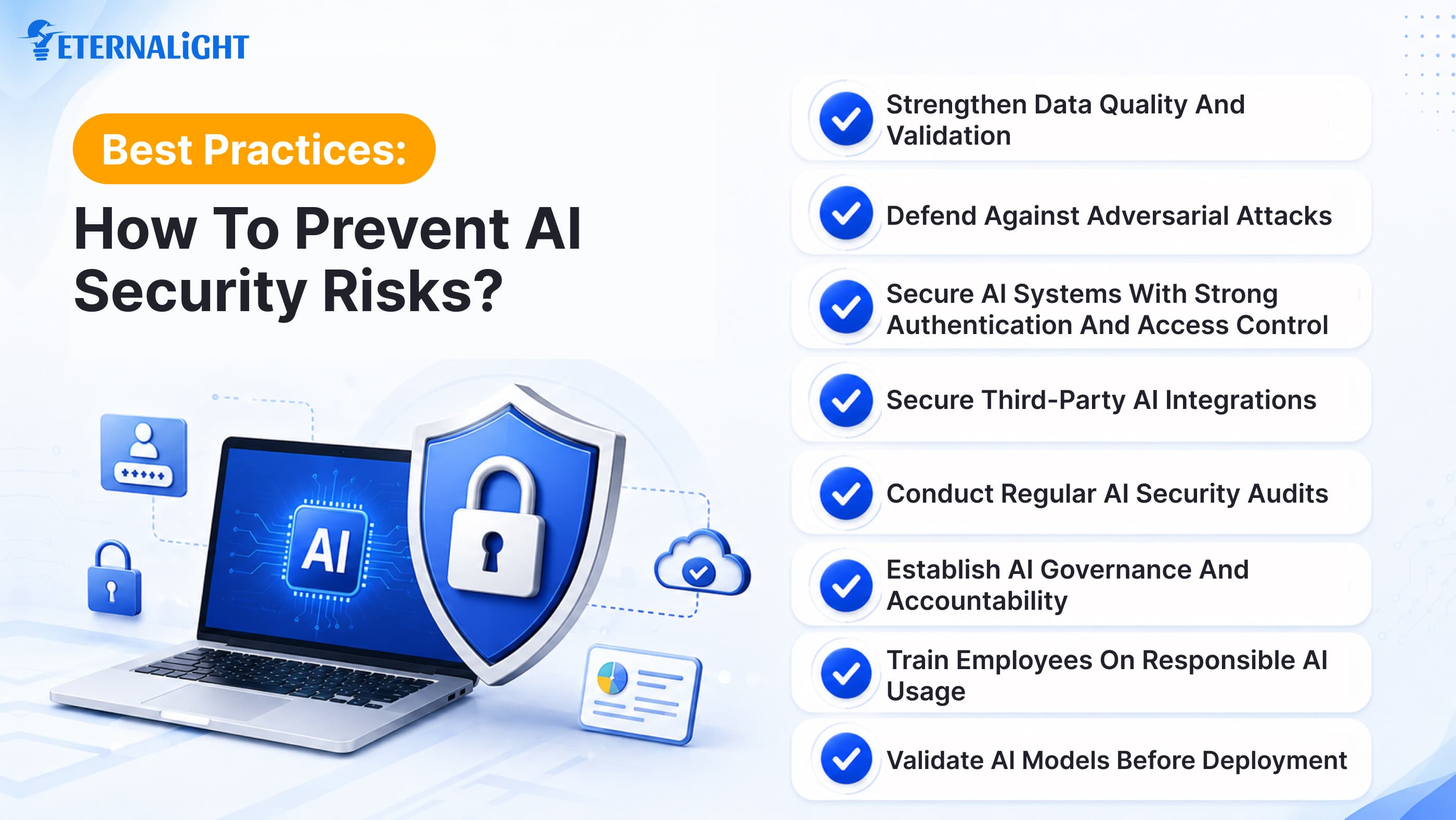
Best Practices: How to prevent AI Security Risks?
Strengthen Data Quality and Validation
You can protect data from poisoning only if you don’t overlook data quality and comply with standards and validation protocols to detect anomalies in data pipelines. It is not that difficult to neutralize and detect threats well before any unpredictability or uncertainty arises. Additionally, data tampering can be reduced by training on diverse, accurate datasets.
Defend Against Adversarial Attacks
Secondly, adversarial attacks on AI systems can be mitigated by training models to identify facts and malicious inputs. Simulate scenarios and apply preprocessing layers to filter data and inputs, and add a defense layer to build a robust ecosystem for AI system deployment.
Secure AI Systems with Strong Authentication and Access Control
Thirdly, encryption is a proven technique to prevent IP from unauthorized access and enable secure data transmission. By setting up standard access control through JWT or multi-step authentication, biometric sensors, OAuth tokens, API keys with validation inputs, and at different points, we can safeguard the AI systems. Furthermore, if a monitoring tool can flag unusual activity and behavior at the right moment, it may eliminate the risk on AI systems.
Secure Third-Party AI Integrations
In the logistics or supply chain industry, we should not use poorly configured third-party tools. If it has any issues or displays an alert, it can put your system at risk; it's better to avoid them and always prioritize the latest software versions to prevent unauthorized exposure.
Conduct Regular AI Security Audits
Perform regular AI and tech stack audits to check whether any unauthorized users are accessing your information or if it's all in a safe zone. This will reduce the risk of data theft and pipeline bursts. Role-based access control accessibility is one of the preferred approaches to reduce data theft.
Establish AI Governance and Accountability
Prioritize transparency, AI-driven authorization frameworks such as NIST AI RMF, governance structures for smooth decision-making, and trust enforcement. Define clear accountability and audit trails with structured documentation to keep everything robust and comprehensive.
Train Employees on Responsible AI Usage
Before introducing any tool across teams, it's better to arrange webinars, courses, or training programs so they can use the tools responsibly without unlocking any risk.
Validate AI Models Before Deployment
Evaluate the datasets, model capabilities, and dependencies before integrating into a new AI app. Also, establish a communication channel and monitor suspicious attempts. Also, as we sign an NDA before any project, establish validation standards and compliance requirements for proper supervision of AI models.
Why Does it Require the Adoption of an AI Governance and Compliance Policy?
To prevent AI security risks, you can’t apply protocols once and then sit back. It needs regular inspection and must continue to evolve with the situation. Preventing cybercriminals from accessing applications and systems isn’t enough to protect security.
When embedding AI integrations or tools across the organization, founders must develop a compliance strategy for how employees will use and access these systems to ensure employees' data and privacy are not compromised.
Limit access by employee designation and responsibilities. Categorize which tools are for cross-functional teams to collaborate or which have limited team and departmental access.
Regularly conducting the AI tool audit process and risk assessment will help discover which third-party integrations and AI tools employees are using. Ask if they’re facing any issues with any tools enabled by the organization.
What's Next to Prevent AI Security Risks
It's been a decade since automation has been injected across every domain, but it's still evolving beyond expectations. Fake audio and video, phishing attempts via email and messages, and abnormal activities by anonymous people are very common.
AI attackers treat humans as data and scan their facial expressions to steal their identity, making people much more vulnerable. However, governments and AI development companies are working to make the world more secure by proposing standard compliance requirements and regulations to address challenging situations.
Integrating AI is not just an additional feature to embed in apps and platforms, but a major responsibility to prevent cyberattacks and threats.
Bottom Line
Trusting AI tools and integration blindly only invites AI security risks across the organization. Thus, founders should strengthen AI compliance and privacy policies and frameworks to prevent potential bottlenecks. One negligence can lead to a dangerous situation. Being prepared in advance will help you recover faster from any sudden disruption and maintain operational flow. Adopting AI can have a positive impact, but it can turn into a disaster if you ignore the warnings and give full control to these tools.

Ayushi Shrivastava
Senior Content Writer
Ayushi is a Content Strategist at Eternalight Infotech with 4 years of experience in transforming complex ideas into clear, engaging, and SEO optimized narratives. She specializes in crafting impactful content strategies that enhance brand visibility and drive meaningful engagement across digital platforms.
Related Blogs
- Software Development11 Mins
Website Security Checklist: What to Check Before It's Too Late
Worried about website security? Use this practical website security checklist to spot common risks and protect your website, data, and users.
- Software Development7 Mins
From Off Track to Success: Custom Software Development Challenges to Fix Early
Custom software projects don’t always go as planned. Learn which challenges to catch early before they become costly problems for your budget, scope, and product.
- Software Development8 Mins
Product-Market Fit vs Revenue: What Should Indian Startups Chase
Product-market fit vs revenue: What should Indian startups focus on first? Explore the right metrics, customer signals, and growth priorities at each stage.