Software Development
9
Mins
Top Mobile App Development Trends to Watch in 2026
Learn about the latest mobile add development trends that are taking over the world in 2026 and beyond.
Top Programming Languages in 2026: What Developers Really Need to Learn Now

Choosing a programming language in 2026 can be confusing and tiring. And every few months, there’s a new technology, framework, or “must-learn” language that everyone rushes to learn. Your LinkedIn feed is chock full of learning updates, job roles are ever shifting, and it sometimes feels like you haven’t even begun when you realize that you’re already behind.
The development team feels this pressure during real-time project planning, as they consider switching jobs and making wise career moves.
Instead of following a new trend, the question becomes: Which programming languages are actually worth your time in 2026?
This blog is here to help you sort that out, without the noise. Whether you’re a student looking to enter tech for the first time, a developer considering upskilling, or someone considering a significant career shift and learning something new in programming, you’ll find clear, practical advice here.
Programming languages today are not just something developers learn; they’re something careers are built on.
They shape:
How people grow in their jobs
How businesses scale and compete
How ideas turn into real-world products
Think about it for a moment.
The apps you open every morning, the websites you endlessly scroll, the job recommendations you receive, and even the interviews you attend, all of it runs on code working quietly in the background.
But here’s the fundamental shift happening in 2026.
Successful developers aren’t the ones trying to learn everything. They’re the ones who understand what to learn, when to know it, and why it matters. They focus on the languages that align with their goals, the industries they want to work in, and the problems they want to solve.
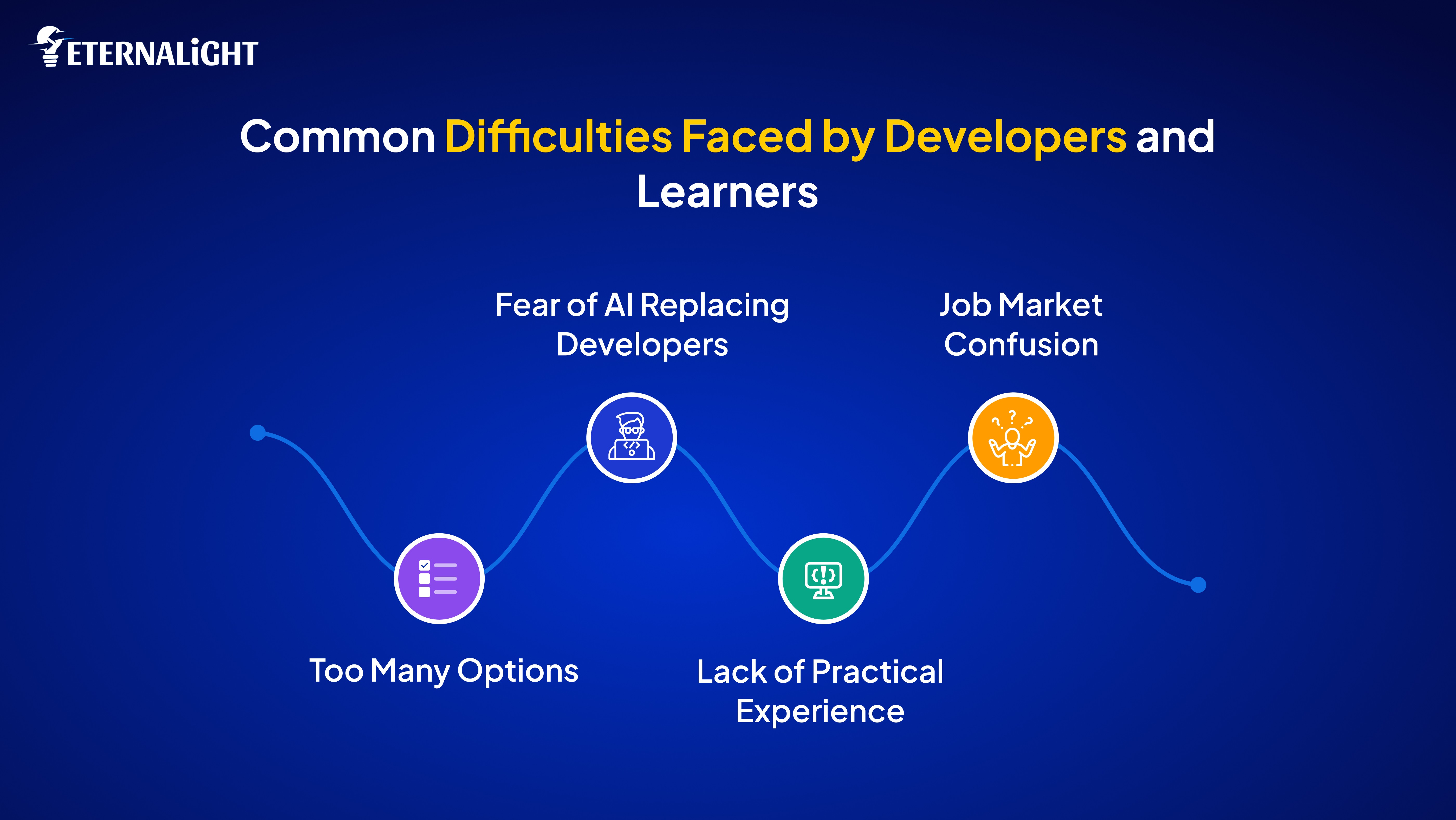
In today’s tech world, choosing the correct programming language in 2026 isn’t just a learning decision; it’s a career decision. Let's uncover the common difficulties:
Python, Java, JavaScript, Go, Kotlin, Rust: where do you even start?
With AI tools generating code, many beginners worry if programming jobs will survive.
Many learners know syntax but cannot build real projects.
What is trending online does not always match what companies are hiring for.
We’ll take a tour of the most in-demand programming languages of 2025, explain where they’re actually used, why companies keep hiring for them, and how you can start learning them in 2026 as a goal.
Python has quietly become one of the world’s most influential programming languages, and its impact in 2025 remained stronger than ever. The reason Python feels so much better is that it is easier to read and write. Someone with no technical experience can read Python code and tell at a glance what it’s supposed to do. This simplicity has made Python very popular in all industries.
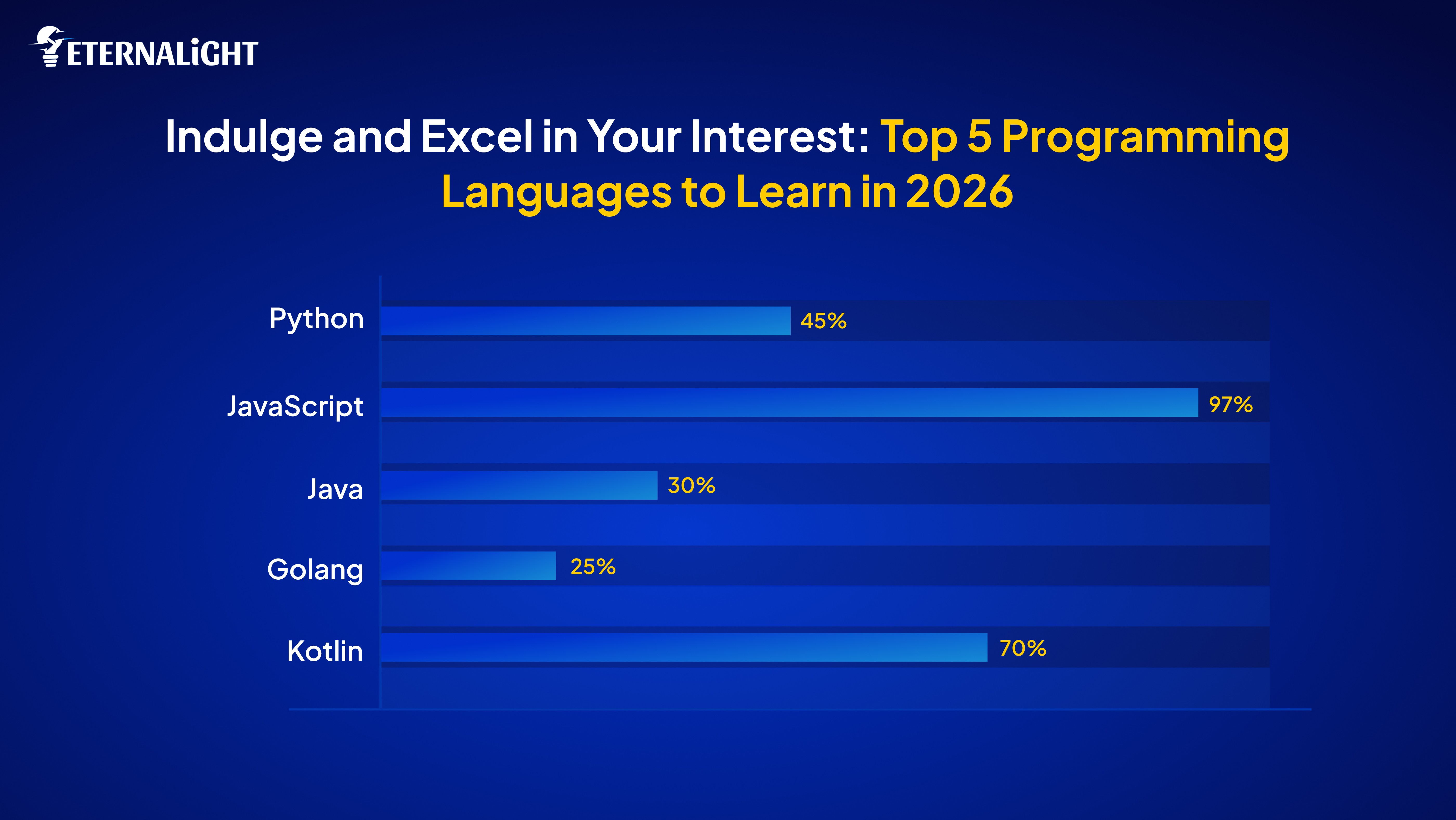
Recent developer surveys indicate that Python is used by over 45% of developers worldwide, making it one of the most widely used languages.
Python is widely used in Artificial Intelligence, Machine Learning, Data Science, automation, and web development.
In the real world, companies are using Python to analyze customer data, predict purchasing trends, automate internal processes, and develop “intelligent” systems from recommendation engines to text-based natural language processing.
Beginners can try it in 2026.
If the internet had a pulse, JavaScript would be the heartbeat. Nearly every website you visit today is an application that uses JavaScript. It’s the language that makes websites interactive, enabling pages to respond nearly instantly when you click, scroll, or submit a form.
More than 97% of all sites across the web use JavaScript: The remaining portion to show you how indispensable it has grown. JavaScript’s greatest strength, however, is likely its flexibility, driven by the rise of Node. JS developers are using JavaScript not only on the front end but also on the back end.
JavaScript is everywhere, from social media sites to e-commerce companies and real-time chat applications. For someone looking to enter web or full-stack development, JavaScript is not just helpful; it’s the one you should definitely explore in 2026.
Java is a decades-old language, but it’s still one of the most reliable choices for large corporations by 2025. The most significant strength of Java is its reliability. Java is recognized for its stability, security, and ease of scaling to complex, large systems without performance degradation.
This is why Java remains the Leading Language in areas such as banking, finance, insurance, and enterprise software. According to the latest industry reports, more than one-third of enterprise applications deployed worldwide are developed in Java, particularly in businesses where data security and system performance are mission-critical.
Java’s platform-neutral nature is another advantage, meaning programs can run on different types of computers without modification. In the IT industry, banks and financial institutions process millions of instructions every day using Java.
According to industry surveys, more than 30% of applications and websites worldwide are still built in Java. Java can run on any operating system with the Java Virtual Machine (JVM), ensuring consistent deployment.
According to tech hiring data, Java backend developers command average salaries 20-30% higher than those of many other generalist programming roles.
Go, also known as Golang, was created by Google to address modern performance challenges. In 2026, it will also be used in the backend and cloud environments. Golang is designed to be fast, efficient, and highly scalable, making it ideal for systems that must handle large volumes of users simultaneously.
Many cloud platforms and DevOps tools rely on Golang because of its ability to manage concurrent processes.
Industry reports indicate that Golang adoption has grown by more than 25% over the past few years, particularly among cloud-native companies.
This fact makes Go especially significant for the developer community focused on developing cloud infrastructure, backend systems, and scalable software platforms.
Kotlin has rapidly grown in popularity over the past few years and represents the modern shift in Android development. Kotlin is developed by JetBrains and officially supported by Google. Now, Kotlin is a preferred language for building Android applications.
Industry surveys indicate that more than 70% of professional Android developers use Kotlin for new projects, and adoption continues to rise.
Kotlin’s biggest strength is its clean, concise syntax, which enables developers to write safer, more readable code with far fewer errors than older languages.
Many popular applications, such as food delivery, travel, and e-commerce, are built and updated using Kotlin.
Artificial Intelligence is already transforming not just how software is developed but also which languages developers choose in 2026.
Thanks to AI-based coding tools such as competent code editors and AI assistants, developers no longer think about syntax as much. They also place greater emphasis on logic and problem-solving.
This trend has also made high-level, user-friendly languages such as Python, JavaScript, and Kotlin even more in demand.
Recent surveys indicate that over 60% of developers now use AI-assisted coding tools, and these tools work best with simple, flexible languages.
It uses AI to help generate code, identify errors, and offer suggestions, smoothing the learning curve for novices while shaving precious time off development for more experienced programmers.
As a result, developers are naturally choosing languages that allow faster development and smoother integration with AI tools.
At the same time, cloud platforms and automation tools are influencing programming language preferences. Backend-friendly, scalable languages such as Go and Java are gaining traction because they integrate well with modern infrastructure and AI-driven systems.
The decision to adopt a new programming language in 2026 is driven more by purpose than by popularity. Python, Java, JavaScript, Kotlin, and Go each address diverse real-world challenges across data and web development, mobile applications, and large-scale backend systems.
There’s no “best” programming language; it depends on what you want to accomplish and the domain you’re interested in.
As tools and AI make coding more accessible, strong programming skills (and practical thinking) matter more than ever. Developers who focus on where and how a language is applied will be better equipped for lasting progress in the tech industry.
Pick one programming language for 2026 and explore it in depth, applying real-world practices to take control!
Stay relevant and in demand by aligning with evolving market needs.

Kusum Sethiya
(Author)
Software Engineer
Contact us
Send us a message, and we'll promptly discuss your project with you.