Are you planning to build and ship an app with a backend-less architecture?
Are you afraid of encountering a backend system that slows down the operations? Thus, modern age developers discovered a new approach and they are developing applications using next.js. Here in this blog, we focus on the tradeoffs and the right approach engineering teams should adopt for rapid and robust development .
Building a Backend-less Application with Next.js
For senior frontend engineers, full-stack teams, and performance-first tech teams
Assumes you already know React & Next.js app development basics. So here we are discussing it from a technical perspective.
Problem Statement (Engineering Context)
Traditional web apps rely on backend servers REST APIs or dedicated BFF services, to handle data, auth, business logic, and integrations. But:
- Backend code introduces operational overhead: hosting, scaling, deployment, logging, and maintenance.
- Teams must invest time in the infrastructure they don’t differentiate on.
- Startups and small teams face high cost, slow iteration, and brittle services when backend responsibilities outpace product needs.
The question becomes:
Can we build a scalable, maintainable app without owning a traditional backend stack?
This isn’t about avoiding backend logic; it’s about offloading or outsourcing it. The shift aims to reduce operational load while retaining full application capabilities.
What “Backend-less” Means in Practice
“Backend-less architecture" is often misunderstood.
What it actually means:
- No managed servers you operate
- No backend code you scale or maintain
Responsibility shifts to:
- Managed services (auth, DB, storage)
- Edge functions / serverless
- API compositions
You still have:
- Authentication & Authorization
- Data persistence
- Business logic
- File uploads
- Integration with external systems
You just do not own the infrastructure or runtime behind it.
In practice, backend-less architecture means a loosely coupled system of managed services + minimal edge/serverless glue logic rather than a monolithic server.
Why Next.js Enables Backend-less Architecture
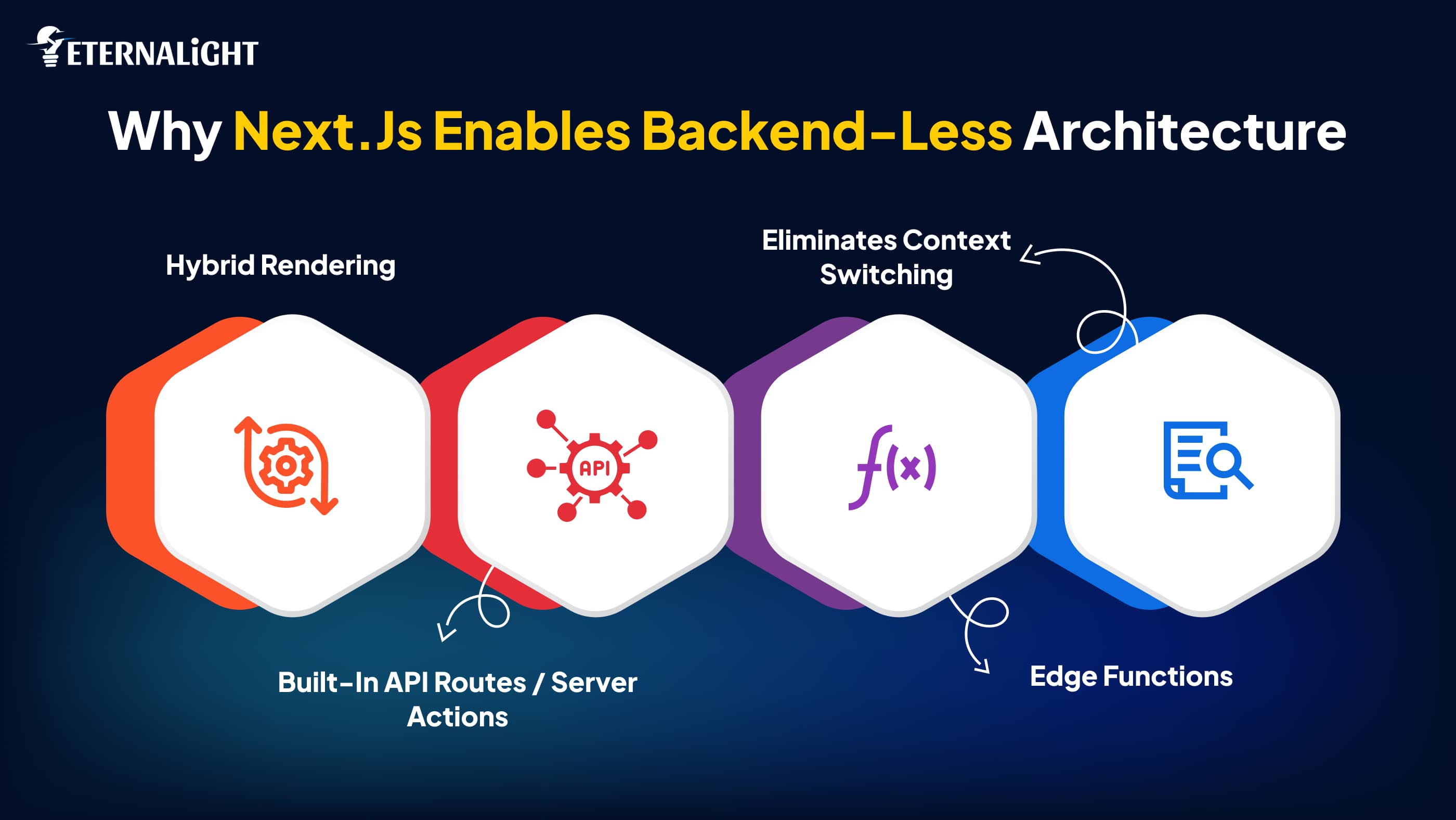
Next.js is popular here not just because it's React + routing but because it blends rendering strategies and compute locations:
Hybrid Rendering
- Static Site Generation (SSG) — pre-build content and cache it close to users.
Incremental Static Regeneration (ISR) — refresh stale data without full rebuilds.
Server-Side Rendering (SSR) — dynamic content at request time when needed.
These allow you to reduce reliance on a backend for most reads. Raft Labs
Built-In API Routes / Server Actions
Next.js lets you bundle lightweight backend logic (auth, simple CRUD) with the frontend code. These are deployed as serverless functions by default. DEV Community
Edge Functions
For low latency compute near the user (e.g., auth checks, personalization) without full servers.
Unified Development
Frontend + lightweight backend logic in one codebase eliminates context switching. Medium
Together, these reduce the need for a separate backend project but they don’t eliminate server logic, they relocate it.
Reference Architecture to Build a Backend less App
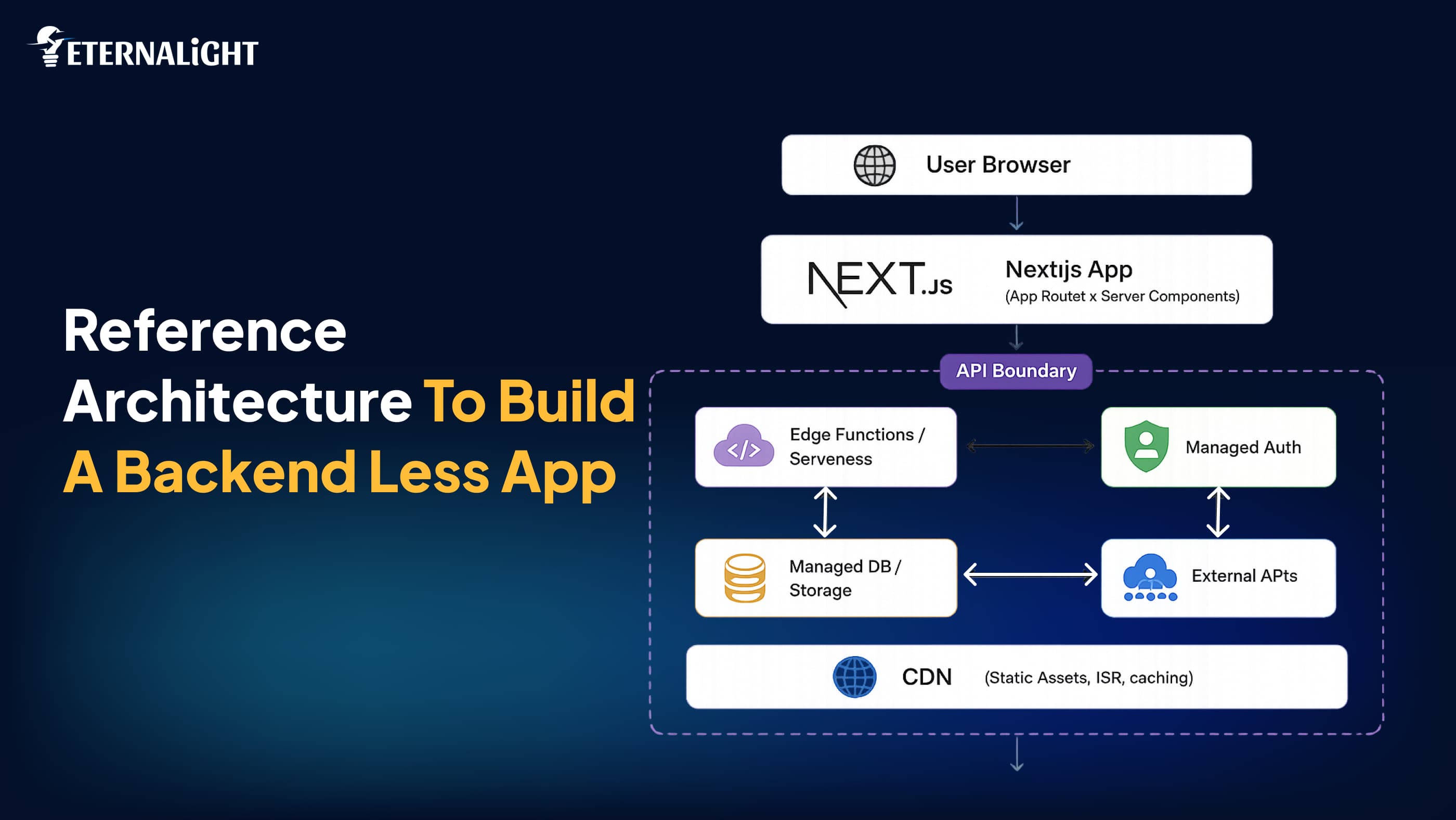
Key layers:
- Next.js frontend — UI + data orchestration
- Edge/Serverless — business logic and secured access
- Managed services — database, authentication, file storage
- CDN layer — caching static content and ISR for speed
This topology removes dedicated backend servers while still supporting full app requirements.
Core Technical Components
Authentication
Use managed auth (providers / IAM) and proxy policies in Edge functions.
Do not expose secrets or tokens to the client.
Data Persistence
Next.js doesn’t ship a database; you use SaaS DBs (e.g., managed SQL/NoSQL).
Careful indexing and cache design matter.
API Glue
Next.js API routes or edge functions can:
- Validate inputs
- Enforce auth policies
- Aggregate multiple backend services
But the heavier the logic, the more brittle your system becomes.
Static vs Dynamic Fetching
Use:
- SSG/ISR for read-heavy pages
- SSR/CSR for dynamic interactions
Tools like SWR offer revalidation and incremental cache updates.
Performance Considerations to Build Backend-less App
Backend-less app using Next.js shines when:
- You maximize static content with SSG/ISR for speed and scalability.
- You offload repeated backend hits to edge functions or CDN caching.
- You avoid cold starts and heavy backend computation by pushing logic to the edge.
Performance pitfalls emerge when:
- Uncontrolled SSR creates bottlenecks.
- API routes are overused for trivial tasks.
- Uncachable dynamic content dominates.
Performance trade-offs are often architectural, not just code-level. Medium
Security Considerations
Security in backend-less architecture systems must be proactive:
Common concerns:
- API surface increases with serverless endpoints.
- Third-party integration exposes new attack vectors. MoldStud
Best practices:
- Validate/auth on the edge before data reaches services.
- Keep secrets out of client bundles.
- Use CSP, CORS, RBAC, hardened HTTP headers.
- Encrypt data in transit and at rest.
Security isn’t easy because the backend is “gone.” It shifts to properly managing identity and edge policies.
Operational / Development Challenges with NextJS
Backend-less shifts complexity rather than eliminates it:
Debugging & Monitoring
- Serverless/edge logs are fragmented.
- You need a centralized observability tooling.
Local Development
- Replicating managed services locally is hard.
- Mocking and feature flags become necessary.
Performance Debugging
- Hot paths span multiple vendors.
- Bottlenecks might be outside your code.
Tooling
- Server configuration is limited, packing too much logic into edge functions can backfire. MoldStud
Best Practices while Developing an App using NextJS
At Eternalight Infotech, we offer top-notch nextjs development services support, adopting the following practices.
- Static-First Rendering — minimize SSR when possible.
- Edge Guardrails — keep edge functions lean.
- Cache Strategically — use CDN + SWR/ISR wisely.
- Abstract Vendor APIs — isolate third-party dependencies.
- Centralize Logs/Traces — choose observability early.
- Security-First Policies — default deny, least privilege.
Also we build app with backend framework alighning your project requirements.
When Backend-less Architecture Works or Fails
From MVPs, SaaS dashboards, CDN systems, and ecommerce stores to some tools, NextJS works best. However, a backend-less app with Next.js is not a silver bullet that can’t be broken, so below are the scenarios where it:
Fails when:
- Complex transactions are core (e.g., banking workflows).
- You need guaranteed consistency across operations.
- Real-time websockets or long-running tasks are required.
- You must expose APIs for multiple clients.
In these cases, a traditional backend or hybrid BFF model is more maintainable, even if it’s heavier to operate.
Conclusion
Next.js empowers teams to build applications without owning backend infrastructure. It:
- Improves iteration speed
- Reduces DevOps overhead
- Delivers high performance when used correctly
But building a backend-less app is not automatic; it’s a pattern with trade-offs. It works when carefully architected and audited, and understanding when it doesn’t is as important as knowing when it does.
.jpeg&w=3840&q=75)
Anish Singh
Senior Software Developer
I'm a backend developer with over 5 years of experience building scalable, reliable, and performance-driven systems. Currently, I work as a Senior Software Developer at Eternalight, where I focus on backend architecture, APIs, and system optimization. I enjoy solving real-world engineering problems and simplifying complex concepts. Through my writing, I share practical backend learnings, system design insights, and experiences from my day-to-day work in the industry.
Related Blogs
 Software Development9 Mins
What All You Should Know Before You Hire a NodeJS Developer?
Hiring a Node.js developer is more than reviewing resumes and comparing costs. Learn the skills, hiring models, costs, interview questions, and key factors that help businesses make the right hiring decision.
 Software Development8 Mins
Angular 22 Release Guide: Features, Benefits & How to Upgrade
Explore Angular 22 features, Signal Forms, AI tools, performance improvements, benefits, and a step-by-step guide to upgrading your Angular app.
- Software Development8 Mins
Shift Left Testing: How Defining Test Cases Early Can Reduce Bugs
Fixing bugs after development wastes time and budget. Learn how shift-left testing and early test case planning help teams build reliable software from day one.